
Summary
Joe Heschmeyer has written a critique of chapter 5 of my book, The Canon of Scripture. Though I will quote him extensively in this rebuttal, his entire essay can be read here: https://shamelesspopery.com/did-prophecy-end-in-400-b-c/
For those who do not want to plod through my more detailed refutation of Joe Heschmeyer's review, let me at least summarize the key points here. As Heschmeyer admits,1 his article is not a review of the book as a whole, but an attempt to refute chapter 5, which seeks to give an exegetical basis for what is known among Protestants as the "intertestamental period" — i.e., the period between the Old Testament and the New Testament writings (400 BC – AD 30). He is correct that it would be "circular reasoning" to presuppose an intertestamental period when that is the point at issue. Roman Catholics believe that there is no intertestamental period since several of their canonical books (the apocrypha) were written during this period. He states that if he can show chapter 5 to be full of errors the reader can safely assume that the rest of the book will be characterized by similarly poor scholarship. My response answers each point and demonstrates that it is actually his review that is riddled with errors.
But in fairness to Mr. Heschmeyer I will acknowledge that the strongest part of his review was his ability to show tensions in my exegesis of Hosea 3:4-5. That is not surprising as many scholars claim that this passage is "one of the most problematical" passages in the Old Testament,2 "notoriously difficult to analyze,"3 with "insoluble problems,"4 and therefore a passage that has "sparked much controversy in the interpretive communities."5 I almost left any analysis of that passage out of the book for precisely those reasons, but since I was trying to deal with all the Biblical evidence, I decided to tackle it. I took the approach of ruling out impossible interpretations by setting interpretive boundaries by means of the least controversial and the clearest portions of the text and letting the more difficult exegetical data land where it would. I believe that of all the interpretive options I have looked at, the one I sided with has the least problems. But in my interactions below I assume (for the sake of the argument) that Heschmeyer is correct in his exegesis and show how even his own interpretation rules out the Roman Catholic view on revelation (besides clearly contradicting some exegetical points). It is tempting to accept his view that the word "teraphim" was intended by Hosea to be a positive term rather than a negative one since that would hugely strengthen my argument. But nowhere else in Scripture are "teraphim" seen as positive. So while I am open to editing my book in the future should I be given a better interpretation, I am currently convinced that my current understanding of this passage is the most likely.
But the data I will present below shows that Mr. Heschmeyer has misrepresented my book, ancient writers, and modern scholars on many points. In order to undermine one of my arguments, he denies that Solomon, the sons of Korah, Luke, and other biblical writers were ever called "prophets." I show numerous church fathers and ancient Jews who counter his claim. Mr. Heschmeyer then claims that I engage in the fallacy of appeal to authority (only citing modern scholars to demonstrate what ancient writers believed rather than citing the ancient authorities myself). Anyone who has read this brief section of my book will know that I cite ten passages from ancient Jewish authorities. In any case, I referenced several scholars who dealt extensively with the ancient literature because I did not want to add another 30-40 pages to the book. He then claims that I only cite Protestants (not true) and implies that I only cited four scholars, whereas I actually cited eleven. He then misrepresents two of those scholars as relying "on a single piece of evidence: a few lines in Josephus." Anyone who has read those two articles knows that those two scholars (as well as others that I cited) interact with a large body of ancient witnesses. This is misrepresentation. But more to the point, he leaves out some critical details from the Josephus quote that completely undermine his position. Having earlier complained that I don't nuance the difference between "prophet" and "prophecies" (but I actually do deal with that whole issue in Appendix A), he fails to reconcile Josephus' complete ruling out of any prophetic Scripture after 400 BC with his willingness to acknowledge recent prophetic (but uninspired) activity. While Josephus is capable of contradictions, as a Pharisee6 it is quite clear that he had a different approach to revelation and canon than Rome does. After quoting Josephus extensively I show how the following conclusions about the opinions of Josephus are irrefutable:
- Josephus believed that all Scripture was written by prophets (contra Heschmeyer)
- Contrary to Heschmeyer, Josephus believes that the books he considers to be "accredited" as canonical are the only ones that have "no discrepancy in what is written" and the Biblical "prophets alone had this privilege" of being free from error (inerrant).
- Thus (contrary to Heschmeyer), the apocryphal books that were written in the period between Artaxerxes and our own day are useful, but are not inspired or inerrant. This rules out 100% of the apocrypha in exactly the same way I did in the book.
- After that period there has been no succession of the kind of prophets who could write with inspiration and inerrancy, and "no one" can add anything to Scripture. This too rules out the apocrypha in his view (again, contrary to Heschmeyer). The apocryphal books held to by the Hellenists were "inconsistent books, conflicting with each other."
- The total number of books considered to be Scripture by orthodox Jews was 22. Again, this coincides with the Protestant canon (understanding that a couple books were grouped together).
- Nothing else written beyond those 22 (however useful) is worthy to be compared with the canonical books.
His attempted use of Scripture to refute my exegesis of Amos 8:11-14 actually proves the opposite. It wasn't preaching that ceased between 400 BC and the time of Jesus (nor did preaching cease after AD 30). What ceased was the giving of objective revelation. He is in a dilemma. If he places the period before Christ, it rules out the apocrypha. If he places it after AD 70, it rules out papal infallibility or continuing revelation through church councils.
Sadly, Mr. Heschmeyer fails to deal with the main portions of the book that demonstrate that the Bible's own self-referential statements rule out Roman Catholic views on revelation and canonicity altogether. It was prophets who determined the canonicity of a book the moment it was written. They didn't wait for hundreds of years for the church to determine it. The church simply recognized the Bible's self-authentication by taking seriously the Bible's self-referential statements. My book also gives extended discussion of how much Rome is out of touch with the Jewish canon, the canonical views of the bulk of church fathers, and the clear notations in the catholic church's official study bible that the apocrypha was not part of Scripture. All it would take to refute Heschmeyer's refutation would be to read his review side by side with my book. But for those who desire a more detailed response, I will continue this paper with a point-by-point rebuttal.
A more extended interaction with Mr. Joe Heschmeyer
In my 2021 book, The Canon of Scripture, I attempt to provide a consistently presuppositional defense of the Protestant (and historic) canon. The first half of the book demonstrates that the Bible is self-authenticating and that the data found in the uncontroversial canonical books (that is, the books recognized by all branches of the church) give us everything we need to recognize the boundaries of the canon. It discusses the Biblical data on a Sola Scriptura approach to tradition, authority, inerrancy, infallibility, self-authentication, etc. The second half of the book gives 190 pages of quotations from the Eastern and Western church fathers, showing that they held to the same Sola Scriptura approach on these areas related to canonicity. It is thus Rome and Eastern Orthodoxy that have jettisoned the historic "catholic" doctrines of the fathers. The Reformation was simply seeking to restore the ancient "catholic" and "orthodox" doctrines. It is therefore understandable that this book will get negative reviews from both Roman Catholic and Eastern Orthodox theologians. Such reviews are welcome, and if there are defects in the book, they will be acknowledged and corrected.
I was recently asked to write a rebuttal of Joe Heschmeyer's review that was posted on the website, Shameless Popery.7 The review asserts that my book is, "riddled with factual errors, exaggerations, misstatements, logical leaps, and outright falsehoods." He is unwilling to point out all the errors because:
Proving any of that for even a few pages is laborious, and virtually impossible for an entire book. So what I've decided to do is to take just one section, show the problems with that, and then allow you to form an educated judgment of the quality of the rest of the book from this demonstration.
I looked forward to seeing what errors he would point out. I will take them in the order that he presents them and show that they are not errors at all.
The following quote from my book is the first thing that he takes issue with:
It was an axiom among Jews that all Scripture was prophetic. Second, it was an axiom among Jews that the Scripture foretold the cessation of all prophecy from 400 BC until the Messiah should arise as the Great Prophet. If these two claims can be backed up by Scripture, then 100% of the apocrypha found in the Roman Catholic canon can be automatically ruled out. (Kayser, p. 86)
Heschmeyer's first argument — not all Scripture writers were prophets
His first argument is given below in full:
The argument here is in the form of a syllogism, but a misleading one. The first claim is that "it was an axiom among Jews that all Scripture was prophetic." Whether or not it was an "axiom among the Jews" or not, I think we can safely grant that any orthodox Jew or Christian could affirm the prophetic dimension of Scripture. But Kayser is going to take "all Scripture was prophetic" as if it means "all Scripture was written by a Prophet," and those aren't really the same thing. Solomon is the traditionally-accepted author of multiple books of the Old Testament, and St. Luke is the author of one of the four Gospels, and several Psalms (cf. Ps. 42:1, e.g.) were penned by "the sons of Korah," who served as gatekeepers for the Temple (1 Chr. 26:19), and helped to lead the people in praise (2 Chr. 20:19). But these aren't normally the people we mean when we talk about "the Prophets." We tend to mean people like Elijah and Elisha, who didn't write any books. So watch out for that shift in the argument — from "Scripture is prophetic" to "all of the authors of Scripture were the Prophets." It's not a valid conclusion, but it's critical to Kayser's argument.
Mr. Heschmeyer brings up a distinction that my book seeks to lay to rest exegetically. While I do show respect toward those who make this distinction (see Appendix A, which discusses Westminster divines who believed in ongoing prophecy yet also believed that inspired prophets ceased in AD 70), I believe that my book successfully demonstrates that this division between prophecy and prophet is a meaningless distinction. It takes a prophet to give prophecy. Mr. Heschmeyer fails to deal with my Scriptural arguments proving that all prophets were inerrant in their prophecies whether they wrote or spoke, that the entire New Testament is what Paul calls "the prophetic Scriptures" (Rom. 16:26), that all prophecy has ceased, that the church is "built on the foundation of the apostles and prophets, Jesus Christ Himself being the chief cornerstone" (Eph. 2:20), that the foundation doesn't keep getting laid throughout history, etc. Since he has not interacted with those arguments, I will simply note that he has made a statement without proving it.
Second, he is out of step with the church fathers on this point (just as he is on canon as a whole). My book has already quoted numerous fathers who contradict him (see pages 183-375 for extensive quotes of the church fathers), but the footnotes here will provide a few more quotes: In contrast to Mr. Heschmeyer, who claims that Solomon was not a prophet, many church fathers explicitly called Solomon a prophet, including Theophilus (bishop of Antioch from 169-182),8 Gregory Thaumaturgus (this bishop is also known as Gregory of Neocaesarea — 213-270),9 Pope Marcellus (255-309),10 Optatus, the bishop of Milevis (wrote from 364-390),11 Hilary, the bishop of Poitiers (310-367),12 Quodvultdeus, the bishop of Carthage (died 450),13 Rabanus Maurus, the archbishop of Mainz (780-856),14 and many others. Though Mr. Heschmeyer is technically correct when he says that the Bible does not explicitly label Solomon, the sons of Korah, Ethan the Ezrahite, Asaph, Luke, John, and others as prophets, the fact that they wrote Scripture was all that was needed for the church fathers to call each one of those a prophet. For example, Lactantius calls Ethan the Ezrahite "the prophet,"15 Theodoret calls the sons of Korah prophets,16 as does the Venerable Bede.17 Origen calls Asaph a prophet when quoting Psalm 81.18 Fulgentius of Ruspe calls the post exilic author of Psalm 126 "the holy prophet."19 Cyril of Alexandria calls John "the blessed prophet."20 In scanning through several volumes of the church fathers I noticed numerous additional references to all of the above Biblical authors as "a prophet," "the prophet," "this prophet," etc.
Third, ancient Jews shared the view that all writers of Scripture were prophets. For example, the Haggidic teachings of Rabbi Ishmael, Rabbi Simeon ben Yohai, Rabbi Aqiba, and others clearly treated Solomon as a prophet. Targum Qohelet describes Solomon as a prophet (1:1; 4:15) and having the spirit of prophecy (1:4; 3:11,14; 4:15; 9:7,10). Likewise Targum Canticles describes Solomon as a prophet (see 1:1,17; 7:2; 8:5,13). As Céline Mangan words it:
Tg.Q. is part of this tradition. King Solomon is described as a prophet (1:1; 4:15) and speaks by means of the spirit of prophecy (1:4; 3:11, 14; 4:15; 9:7, 10) and by means of the Holy Spirit (1:2; 2:13; 8:12, 14). Tg.Cant. (1:1, 17; 7:2; 8:5, 13) which has many affinities to our Targum, also describes Solomon as a prophet. The nature of these prophecies is spelled out in Tg. 1 Kgs. 5:13.21
John Davies gives an extended discussion of why Solomon was treated as a prophet by Jews and by the early church even though the word "prophet" was not given to him in Scripture.22 He starts by saying:
The idea of Solomon as a prophet may appear startling at first (other than to Muslims who have long honored "Prophet Suleiman"). He is nowhere identified in Scripture by the title נביא ("prophet") or any of the other terms roughly synonymous with it. Yet the writer of 1 Kings does in a sense cast a prophetic mantle over Solomon.23
Heschmeyer's second argument — Mr. Heschmeyer says that I engage in the fallacy of appealing to authority when I cite experts on Jewish belief rather than quoting the Jews themselves
I will deal with his sub-arguments one by one. He starts by saying, "To support this claim, Kayser doesn't quote a single ancient Jewish source." This is simply not true. I cite ten passages from ancient Jewish sources as supporting my view. My goal was not to give an exhaustive treatment, but a representative treatment, so I cited:
- 1 Maccabees 4:46; 9:27; 14:41
- 2 Maccabees 15:38
- 2 Esdras 14:45
- The Talmud (especially "Baba Bathra" 12a, 12b, 14b-15c; and "Sanhedrin" 11a; "TB Yoma" 21b
Each of those citations of ancient Jewish sources clearly support my view.
His second complaint is:
Instead, he cites to a few other Protestants: namely, Milton C. Fisher's "The Canon of the Old Testament," from the Expositor's Bible Commentary; George L. Robinson and R.K. Harrison's "Canon of the Old Testament," from the International Standard Bible Encyclopedia; David G. Dunbar's "The Biblical Canon," from Hermeneutics, Authority, and Canon, by D.A. Carson and John D. Woodbridge.
Just for the record, I don't only cite Protestants. In my brief discussion I not only cited the ancient Jewish authors listed above, but I also cited the noted Jewish teacher of the Talmud at the Landesrabbinerschule.
Second, the word "namely" implies that he is giving a complete record of who I cite. But it is not complete. Other writers that he fails to note are:
- William Whitaker, A Disputation on Holy Scripture.
- Norm Geisler, "Extent of OT Canon," in Gerald F. Hawthorne (ed), Current Issues in Biblical and Patristic Interpretation.
- Ludwig Blau, "Biblical Canon," Jewish Encyclopedia.
- F. F. Bruce, The Canon of Scripture.
- J. A. Motyer and M. J. Selman, "Teraphim," in D. R. W. Wood, et al, New Bible Dictionary.
- David Farnell, "The Gift of Prophecy in the Old and New Testaments," in Bibliotheca Sacra.
- David Baron, The Ancient Scriptures and the Modern Jews, and others.
He goes on with a third statement:
- The first two of these sources [Milton Fischer's and George Robinson/ R. K. Harrison's] rely on a single piece of evidence: a few lines in Josephus' Against Apion, in which he says:
- "For we have not an innumerable multitude of books among us, disagreeing from, and contradicting one another: [as the Greeks have:] but only twenty two books: which contain the records of all the past times: which are justly believed to be divine. (8) And of them five belong to Moses: which contain his laws, and the traditions of the origin of mankind, till his death. This interval of time was little short of three thousand years. But as to the time from the death of Moses, till the reign of Artaxerxes, King of Persia, who reigned after Xerxes, the Prophets, who were after Moses, wrote down what was done in their times, in thirteen books. The remaining four books contain hymns to God; and precepts for the conduct of human life. 'Tis true, our history hath been written since Artaxerxes very particularly; but hath not been esteemed of the like authority with the former by our forefathers; because there hath not been an exact succession of Prophets since that time."
First, it is absolutely false that the two articles referenced by him rely on "a single piece of evidence." Both articles sort through all the ancient relevant literature and show how even the apocryphal and pseudepigraphal books give evidence (negatively and positively) for the canon. For example, Robinson and Harrison's discussion of Philo (as careless as Philo was on the doctrine of inspiration) shows that "Philo never quotes any of the apocryphal books" (p. 596). Even the discredited book of 4 Esdras (after a fanciful story of the Bible being lost and Ezra rewriting everything plus more) says, "Make public the twenty-four books that you wrote first... but keep the seventy that were written last, in order to give them to the wise among your people." (2 Esd. 14:45f). Robinson and Harrison's conclusion from this book is:
The story is obviously pure fiction. It is no wonder that a new version of it arose in the 16th cent., according to which the canon was completed not by Ezra alone, but by a company of men known as the Great Synagogue. From the legend of 4 Esdras, however, it is commonly inferred that the twenty-four books that remain after subtracting seventy from ninety-four are the canonical books of the OT. This would make it the first witness we have to the number of books contained in the OT canon. This number corresponds exactly with the usual number of sacred books according to Jewish count, as we saw above (I.C.). The legend is therefore not without value. Even as legend it witnesses to a tradition that existed as early as the 1st Christian cent., to the effect that the Jews possessed twenty-four specially sacred books. It also points to Ezra as the chief factor in the making of Scripture and intimates that the OT canon has long since been virtually closed.24
And both articles similarly analyze many other sources of evidence. Mr. Heschmeyer may dispute the conclusion Harrison comes to from this source material, but it is not fair to say that he or Fischer relied solely upon one line of evidence from Josephus.
Second, Mr. Heschmeyer conveniently left out the most significant parts of even the Josephus quote (especially note the bold text below). Josephus said:
[37] It therefore naturally, or rather necessarily, follows (seeing that with us it is not open to everybody to write the records, and that there is no discrepancy in what is written; seeing that, on the contrary, the prophets alone had this privilege, obtaining their knowledge of the most remote and ancient history through the inspiration which they owed to God, and committing to writing a clear account of the events of their own time just as they occurred)---it follows, [38] I say, that we do not possess myriads of inconsistent books, conflicting with each other. Our books, those which are justly accredited, [39] are but two and twenty, and contain the record of all time.
Of these, five are the books of Moses, comprising the laws and the traditional history from the birth of man down to the death of the lawgiver. This period falls only a little short of three thousand years. From the death of Moses until Artaxerxes, [40] who succeeded Xerxes as king of Persia, the prophets subsequent to Moses wrote the history of the events of their own times in thirteen books. The remaining four books contain hymns to God and precepts for the conduct of human life.
[41] From Artaxerxes to our own time the complete history has been written, but has not been deemed worthy of equal credit with the earlier records, because of the failure of the exact succession of the prophets.
[42] We have given practical proof of our reverence for our own Scriptures. For, although such long ages have now passed, no one has ventured either to add, or to remove, or to alter a syllable; and it is an instinct with every Jew, from the day of his birth, to regard them as the decrees of God, to abide by them, and, if need be, cheerfully to die for them. Time and again ere now the sight has been witnessed of prisoners enduring tortures and death in every form in the theatres, [43] rather than utter a single word against the laws and the allied documents.25
From this quote we can conclude that Josephus believed the following:
- All Scripture was written by prophets (contra Heschmeyer)
- Contrary to Heschmeyer, Josephus believes that the books he considers to be "accredited" as canonical are the only ones that have "no discrepancy in what is written" and the Biblical "prophets alone had this privilege" of being free from error. That is, only the 22 books of the Hebrew canon are inerrant.
- Thus (contrary to Heschmeyer), the apocryphal books that were written in the period between Artaxerxes and our own day are useful, but are not inspired or inerrant. This rules out 100% of the apocrypha in exactly the same way I did.
- After that period there has been no succession of the kind of prophets who could write with inspiration and inerrancy, and "no one" can add anything to Scripture. This too rules out the apocrypha in his view (again, contrary to Heschmeyer). The apocryphal books held to by the Hellenists were "inconsistent books, conflicting with each other." Thus, even the prophecies of contemporary prophets were not inspired, inerrant, or authoritative for Jews like Josephus. They were certainly not canonical.
- The total number of books considered to be Scripture by orthodox Jews was 22. Again, this coincides with the Protestant canon (understanding that in the Hebrew canon a couple books were grouped together).
- Nothing else written beyond those 22 (however useful) is worthy to be compared with the canonical books.
Mr. Heschmeyer then starts getting into more substantive arguments. He says:
- Significantly, Josephus doesn't actually claim that "all prophecy ceased." His argument was that the "exact succession of Prophets" had been interrupted, giving the later book an inferior authority. And there's nothing in Josephus to support the idea that (a) this would only last until the time of the Messiah, or (b) this divine silence was predicted by Scripture. As far as I can tell, Kayser is making those bits up — I'm not finding them in any of his cited sources.
First, in footnote 8 of my book I clearly acknowledged that Josephus spoke of John Hyrcanus as having the gift of prophecy. My opinion is that this is either a contradiction of the above passage or (more likely) an acknowledgement that the word "prophecy" could be applied to non-inspired predictions or guidance (see point 10 above). If it is the latter, then Josephus is arguing in much the same way that some Westminster divines did (see my extended discussion of this in Appendix A). But that belief in ongoing prophecy does not nullify Josephus' clear statement that the succession of Scripture prophets had ended. The key point being debated is whether the Apocrypha is part of Scripture, and Josephus in this passage clearly rejected the books that Rome claims to be Scripture. He was a cessationist on Scripture, but not on uninspired prophecy/guidance. I happen to disagree with Josephus' use of the term "prophecy" for later guidance that people received, but in my book I show how the Protestant canon can be defended with either belief. Certainly Josephus argued against the Roman Catholic position. And he certainly argued that nothing could be added to what the Scriptural prophets had written.
But Mr. Heschmeyer next asserts, "And there's nothing in Josephus to support the idea that (a) this would only last until the time of the Messiah, or (b) this divine silence was predicted by Scripture. As far as I can tell, Kayser is making those bits up -- I'm not finding them in any of his cited sources." The modern scholars I cited clearly believe that the messianic expectations leading up to AD 70 were because the Old Testament predicted the Messiah to come at some time in the first century. But I will start with Josephus, since that is the original source he is questioning. Josephus' exposition of the visions of Daniel (Antiquities X.xff; XII.vii.6) show that he saw Daniel's prophecies of future kingdoms as being sequential kingdoms that ended with Rome. He doesn't seem comfortable letting the public know in print what he believed about the destruction of the last kingdom prophesied by Daniel (see Antiquities X.x.4), but he clearly sees the destruction as future to him. Since he was at Titus' good will to stay alive, it is certainly understandable why he would not want to say in print what he believed on this subject. But it is hard to escape the conclusion that he believed he was in the Messianic age or that Rome was the third empire to fall. Whiston comments on this passage:
Of this most remarkable passage in Josephus concerning the 'stone cut out of the mountain, and destroying the image,' which he would not explain, but intimated to be a prophecy of futurity, and probably not safe for him to explain, as belonging to the destruction of the Roman empire by Jesus Christ, the true Messiah of the Jews, take the words of Havercamp (10.4): "Nor is this to be wondered at, that he would not now meddle with things future, for he had no mind to provoke the Romans, by speaking of the destruction of that city which they called the Eternal City."26
Josephus also deals with other prophecies of Daniel as being literal sequences of kingdoms. It was this knowledge that they were living in the times of the fourth empire (see especially the 490 years prophesied in Daniel 9:24-27), that led many Jews like Josephus to have messianic expectations. Josephus recognizes and rejects various false prophets who claimed to be the fulfillment of Old Testament prophecy, but even his treatment of these false messianic pretensions show that Josephus took seriously that the timing for such messianic expectations had some merit. After dealing extensively with the messianic expectations found in the Gospels, Emil Schürer says:
The whole multitude hailed Him as the Messiah (Matt. 21; Mark 11; Luke 19; John 12). Such scenes are only to be explained on the assumption, that the Messianic hope was, before His appearance, already active in the nation.
This also needs no proof for the period after Christ. The numerous popular tumults of a politico-religious kind, which took place in the time of the Roman procurators ([a.d.]{.smallcaps} 44--66), give sufficient evidence of the feverish tension, with which a miraculous intervention of God in history and the appearance of His kingdom on earth were expected. How else could men such as Theudas the Egyptian have found believers for their promises by hundreds and thousands? Even Josephus superabundantly confesses, that the Messianic hope was one of the most powerful levers in the great insurrection against Rome. He himself did not indeed shrink from applying the Messianic prophecies to Vespasian, and in this respect he found approving faith from Tacitus and Suetonius.
On the state of the Messianic hope after the destruction of the temple, and during the last decades of the first century after Christ, we have copious information in the Apocalypses of Baruch and Ezra.27
Since I only devote a tiny paragraph to this issue in my chapter, I didn't feel the need to multiply quotes. But since the integrity of the scholars that I was quoting has come into question, I am showing at least some of the evidence in this reply.
At this point it might be worthwhile for me to deal with the debate of whether Josephus was an unbelieving Jew (as I think) or whether he was a Christian Ebionite (as some scholars believe). Either way, there is another paragraph that shows Josephus having some messianic expectation. Jews like Josephus were looking forward to a prophet like Moses. Granted, there is huge controversy over whether Josephus himself believed that Jesus could be the Christ when his works says about Jesus "as the divine prophets had foretold these and ten thousand other wonderful things concerning him."28 Many believe this was a later interpolation by Christians. I believe the following discussion by Dickson gives a balanced view on that subject. He says:
More has been written on this single paragraph than on any other section in Josephus' works (which I am sure would have disappointed Josephus). Part of the reason for this is that the text, while clearly referring to Jesus of Nazareth, shows signs of Christian "tampering." Somewhere along the line a Christian scribe copying out Jewish Antiquities appears to have added phrases so as to make Josephus' original statement about Jesus (which was probably neutral or negative) quite glowing. Nevertheless, there is a wide consensus among scholars (whether Jewish, Christian or otherwise) that Josephus wrote the main sentences of Jewish Antiquities 18.63-64. Let me quote the passage with the (probable) Christian additions placed in square brackets:
At this time there appeared Jesus, a wise man [if indeed one ought to refer to him as a man]. For he was a doer of startling deeds, a teacher of people who received the truth with pleasure. And he gained a following both among many Jews and among many of Greek origin. [He was the Messiah-Christ.] And when Pilate, because of an accusation made by the leading men among us, condemned him to the cross, those who had loved him previously did not cease to do so. [For on the third day he appeared to them again alive, just as the divine prophets had spoken about these and countless other marvellous things about him.] And up until this very day the tribe of Christians, named after him, has not died out.
Readers who have previously looked into this issue may feel I have too quickly bracketed off the words "Messiah-Christ" and "appeared to them again alive." They may be right. The text just quoted is based on the available Greek manuscripts of Josephus' work. One important Arabic manuscript, however, contains the more hesitant words "he was perhaps the Messiah-Christ" and "they reported that he had appeared to them three days after his crucifixion and that he was alive." Since no Christian copyist/translator would have added such reticent statements about Jesus' messiahship and resurrection, there is reason to believe this Arabic manuscript preserves Josephus' original sentiment at this point. These two bracketed sections, then, would not be creations of a Christian copyist but simply "improvements" of an originally hesitant or sceptical statement. On this analysis, the more plausible reconstruction of the paragraph—with Christian bits removed entirely—would be as follows:
At this time there appeared Jesus, a wise man. For he was a doer of startling deeds, a teacher of people who received the truth with pleasure. And he gained a following both among many Jews and among many of Greek origin. He was perhaps the Messiah-Christ. And when Pilate, because of an accusation made by the leading men among us, condemned him to the cross, those who had loved him previously did not cease to do so. For they reported that he had appeared to them three days after his crucifixion and that he was alive. And up until this very day the tribe of Christians, named after him, has not died out.
Whichever reconstruction we prefer—and I lean only slightly toward the latter—there is little doubt Flavius Josephus provides important, independent testimony to (at least) Jesus' fame as a teacher, wonder-worker and martyr during the governorship of Pontius Pilate (AD 26-36).
Two sections later, in Jewish Antiquities 20.200, Josephus again mentions Jesus. This time there is no hint of modification by later copyists. Josephus is describing the deeds of Ananus, the high priest of Jerusalem. In passing he mentions Ananus' treatment of a man named James who is described as the "brother of Jesus":
But this younger Ananus, who, as we have told you already, took the high priesthood, was a bold man in his temper, and very insolent.... He assembled the Sanhedrin of judges, and brought before them the brother of Jesus the so-called Messiah-Christ, whose name was James, and some others. When he had formed an accusation against them as breakers of the law, he delivered them over to be stoned to death.
The appearance here of the words "the so-called Messiah-Christ" strengthens the case for the inclusion of the words "he was perhaps the Messiah-Christ" in the previous passage, for it seems Josephus is speaking about someone he has already referred to by that title.29
Whether or not Josephus penned those words, most scholars agree that Second Temple Jews had an increasing expectation that the time of the coming Deliverer was approaching — and thus the rise of false prophets pretending to be this Messiah. Nor is David Aune the only scholar who held to these views. Quotes from other scholars could be multiplied as they have wrestled with the extant evidence of the Second Temple period. Here is one more from the Lexham Bible Dictionary:
Rabbinic reflection on the Second Temple period holds that prophecy like that found in the Old Testament ceased after Malachi was written (see Aune, Prophecy in Early Christianity, 103--04). Sandmel objects to this, arguing, "Outside from the circle of the Rabbinic Sages, the view that prophecy had ended simply did not exist" (Sandmel, Judaism and Christian Beginnings, 174). Yet there is evidence from 1 Maccabees that other portions of Second Temple Judaism agreed with the rabbinic interpretation. For example, 1 Maccabees 9:27 says, "Thus there was great distress in Israel, such as had not been since the time that prophets ceased to appear among them." Other verses similarly reflect anticipation of the day when a prophet should return to lead and instruct the people (1 Maccabees 4:45--6; 14:41). While this may simply reflect the present lack of a prophetic leader, it is evidence that there were others in the Second Temple period who may have believed prophecy to have ceased with Malachi.
This perception of Second Temple Judaism has endured throughout the years, giving the impression that Jews of this era did not believe in the continuation of the prophetic tradition after the completion of the Old Testament text. Jews of this period saw prophecy as intimately connected to the presence and ministry of the Holy Spirit, which was an eschatological gift of God (Aune, Prophecy in Early Christianity, 104). For apocalyptic sects like the Qumran community, who believed that the eschaton was imminent, belief in the presence of the Holy Spirit working in their community was coupled with the manifestation of prophecy (Collins, Apocalyptic Imagination, 145-76).30
Benjamin Sommer gives an extended treatment of the Talmudic view that prophecy ceased from about 400 BC and would resume when the Messiah came. Here is a very brief quote from his long article. This only gives a summary of why Josephus' references to prophets in the AD 66-70 do not disprove the Talmudic belief that prophecy ceased. He says:
[In the Talmud] The Messiah himself will have the gift of prophecy according to b. Sanh. 93a-b. Following Mal 3:22-24, many sources maintain that the return of the Messiah will be accompanied or preceded by the return of the prophet Elijah and hence also the return of prophecy (Sir 48:1-12; Matt 17:9-13; Pesiq. R. 35, end; Gen. Rab. 71:9; 99:11). The idea that prophecy has departed from Israel but will return at the end of days seems to underlie 1 Macc 4:46 and 14:41, and may be implied by 2 Apoc. Bar. 85:3 and Acts 2:14-36.
In light of this, most of the examples of prophecy in Josephus and the NT are not surprising. Almost all the examples in Josephus come from the time immediately preceding the great revolt in 66-70 CE, a revolt that had strong messianic overtones. Since the reappearance of prophecy on the eve of the eschaton is a normal feature of the ideology according to which prophecy went into eclipse, these examples do not indicate that prophecy was thought to have existed throughout the Second Temple period.31
Heschmeyer's third argument — not all Jews were united in their beliefs
Heschmeyer next says:
Even though they're relying on a single source (and not from the time period in question), Robinson and Harrison argue that "it was the uniform tradition of Josephus' time that prophetic inspiration had ceased with Malachi." How can they make such a sweeping claim? They don't really support it except with an argument from silence: "[Josephus] does not pause to give any account of the closing of the canon; he simply assumes it, treating it as unnecessary." But by their own admission, "Josephus' statements concerning the antiquity of the Jewish canon is the language not of a careful historian, but of a partisan in debate."
In other words, Josephus is trying to show the superiority of Jewish culture over Greek culture on the basis that "we have not an innumerable multitude of books among us, disagreeing from, and contradicting one another: [as the Greeks have:] but only twenty two books." So it's not hard to understand why he might pass over the well-known debates within Judaism, because these debates undermine his argument. (Analogy: imagine that you wrote about how Christianity is better than moral relativism because there's a clear sense of right and wrong. In that argument, you might not include details about the amount of conflict within Christianity. And now imagine that this single piece of evidence was used to "prove" that Catholics, Orthodox, and Protestants were all united on moral issues in the year 2020. That's what's happening with Josephus' argument. )
So as not to be too tedious in dealing with each misstatement, let me be brief:
- I've already dealt with his false statement, "Even though they're relying on a single source."
- He does make a legitimate point that there were "debates within Judaism," if one includes the Hellenists within the term "Judaism." But Josephus explicitly contrasts the myriads of books accepted by the Hellenists and "our books, those which are justly accredited" by the Jews and that "every Jew" reveres the canon of 22 books to which "no one has ventured either to add, or to remove, or to alter a syllable; and it is an instinct with every Jew, from the day of his birth, to regard them as the decrees of God." When I use the term "ancient Jews," I am referring to the Hebrews, not to the compromised Hellenists. Even in the New Testament there was a rift between the Hebrews/Jews and the Hellenists (see Acts 6:1; 9:29; 11:20). The Hellenists accepted books that no branch of the modern church accepts and were considered compromised.
Heschmeyer continues:
Did Josephus actually believe that all prophecy had ceased in 400 B.C.? He did not. In his historical account Antiquities of the Jews, Josephus makes clear that he believes that there continued to be prophets even after the time of Artaxerxes. For instance, he tells of an Essene named Judas "who never missed the truth in his predictions," predicted the exact day on which Antigonus I Monophthalmus would die in 301 B.C.. When the day was nearly over, right when it seemed that Judas would be proven to be a false prophet, the prophecy came true. Nevertheless, Josephus says, "this event put the prophet into a great disorder." Whether or not you believe this account, it's clear that Josephus did, and that he regarded Judas the Essene as an authentic prophet, despite it being 100 years into the alleged 400 years of divine silence.
David Dunbar, the third of Kayser's sources, doesn't actually say (as Kayser claims) that the Jews before Christ were aware of some Scriptural argument about the end of prophecy, Dunbar says only that "at least a century before the Christian era, the Jews were conscious that prophecy in its classical form belonged to the past." In fact, he relies on the Lutheran scholar David Aune for the proposition that while the term "prophet" was customarily used "only of the classical Israelite prophets or of the eschatological prophets who were expected to appear at the end of the age," "various manifestations of prophecy continued among the Palestinian Jews throughout the Second Temple period" [516 B.C. -- 70 A.D.], the exact period during which Kayser claims (on the basis of Dunbar!) that prophecy wasn't continuing.
I've already dealt with each of these arguments. My book acknowledged that some (like Josephus) used the word "prophecy" to refer to guidance from the Lord. But it does not do away with his clear distinction between that and Scriptural prophecy, which ceased. And if the reader reads the authors I cited, he will see much more evidence.
Heschmeyer continues:
So to summarize: there's one source, Josephus, writing in the year 100, claiming that the "exact succession of prophets" ended in 400 B.C., and that's why books written after that are of inferior authority. There's no evidence that this was a universal belief in 100, or in 1 A.D., or in 100 B.C., or even that anyone other than Josephus believed it. And Josephus' own views include a belief that prophecy did continue in some form even after 400 B.C. Given this, it's hard to take seriously the claim that "the view of the Jews in the first century" was that "all prophecy cease[d] between 400 BC and the coming of Christ."
I think my previous citations clearly show his conclusion to be false. I think the quotes above show that all Scriptural prophecy was believed to have ceased by Hebrew Jews. And I've already cited more evidence than simply Josephus. Just to quote one from the Maccabean period:
Thereupon they began to search and track down Judas' friends and brought them to Bacchides, who inflicted punishment and wanton torment upon them. Grievous trouble came upon Israel such as had not occurred from the time that prophets ceased to appear among them. (1 Maccabees 9:26-27)32
Heschmeyer's fourth argument — Kayser's exegesis of Hosea 3:1-5 is not credible
In the next section of Heschmeyer's review, he deals with my exegesis of Hosea 3:4-5, which says:
Hos. 3:1 Then the LORD said to me, "Go again, love a woman who is loved by a lover and is committing adultery, just like the love of the LORD for the children of Israel, who look to other gods and love the raisin cakes of the pagans." 2 So I bought her for myself for fifteen shekels of silver, and one and one-half homers of barley. 3 And I said to her, "You shall stay with me many days; you shall not play the harlot, nor shall you have a man---so, too, will I be toward you." 4 For the children of Israel shall abide many days without king or prince, without sacrifice or sacred pillar, without ephod or teraphim. 5 Afterward the children of Israel shall return and seek the LORD their God and David their king. They shall fear the LORD and His goodness in the latter days.
Heschmeyer's critique of my exegesis of Hosea 3:1-5 is by far the strongest part of his paper as he is successful in showing that my interpretation produces a lack of symmetry within the three couplets of verse 4. What I will seek to demonstrate is that when an artificial symmetry is imposed upon verse 4, it automatically produces outright contradictions. I will also show that having a mix of bad and good in verse 4 is absolutely essential if we are to take seriously the interpretive connection between verses 3 and 4 (see the "For" - כִּ֣י at the beginning of verse 4). But first, let me quote his critique.
According to him, it means that Israel is lacking six things, a random mixture of good and bad things. At this point, his argument is so convoluted that it's worth charting it out:
| Kings (Good) | Princes (Good) |
| Pagan Sacrifices (Bad) | Pagan Sacred Pillars (Bad) |
| Ephod (Good) | Teraphim (Bad) |
This butchers the meaning of Hosea's prophecy, in which Israel is compared to an adulterous woman who is eventually reconciled with her husband (Hosea 3:1-2). Likewise,
the children of Israel shall dwell many days without king or prince, without sacrifice or pillar, without ephod or teraphim. Afterward the children of Israel shall return and seek the Lord their God, and David their king; and they shall come in fear to the Lord and to his goodness in the latter days. (Hosea 3:4-5).
Very clearly, Israel has cut herself off from God in some important respects here, and needs to be reunited. She's presented as willingly playing the adulteress, and she's the one who needs to "return and seek the Lord." Kayser captures none of that in his exegesis, in which it is God who separates Himself from Israel (but cutting off prophets for no apparent reason) and God who reunited Himself to Israel (through the Incarnation). As bizarre as this may be, Kayser's exegesis would seem to make God the adulteress, not Israel.
Apart from the gross misrepresentation of my position here, what Heschmeyer fails to let his reader know is that my interpretation of the three couplets is the most common one. Of the 166 commentaries that I own on the book of Hosea, the vast majority take the six items in verse 4 as containing a mixture of good and bad. Here are some samples:
- "The reader should notice that the list of things Israel will lose for "many days" includes both licit and illicit items."33
- "It interprets the withdrawal of all these cherished things—good, bad and indifferent alike—as ultimate gain."34
- "we must note that with the three pairs of negations, legitimate as well as illegitimate contact is prevented."35
- "So, orthodox and heterodox features alike would now be taken away."36
- "Thus the people will be without proper or improper means of worship."37
- "Notice that, as with Gomer, both legitimate and illegitimate relations are denied Israel."38
- "The overall meaning of v 4 is that both good and bad will be swept away as Israel undergoes a time of purifying."39
See also Coffman,40 Hubbard,41 Sweeney,42 JFB,43 Spence-Jones,44 Keil & Delitzsch,45 Fausset,46 Burroughs, 47 Clarke,48 Drake,49 Gaebelein,50 Bassett,51 Downame,52 Poole, 53 and others. I picked these names because they represent a broad spectrum of theological opinion, yet they felt forced by the data found in verses 1-5 to take the three couplets as having a mix of good and bad. If I have butchered the text, then so have these recognized scholars.
Second, as these same scholars have noted, the "For" (כִּ֣י) at the beginning of the text necessitates a tight connection between verses 3 and 4. One is epexegetical of the other. If there is a denial of both legitimate and illegitimate sex for some days in verse 354 (the symbol), one would expect that there would be a denial of both legitimate and illegitimate desires in verse 4. As James Coffman words it:
McKeating and others felt that all of the things mentioned here were legitimate institutions denied to Israel during the period of waiting; while others as firmly suppose that none of these things was actually legitimate, even the institution of the king being viewed, not as the will of God, but as God's rejection (1 Samuel 8). The truth would appear to be that Hosea simply means that none of these things, whether legitimate, or illegitimate, would be available for Israel during the days of their captivity. This would appear to be supported by the fact that Gomer was denied intercourse, whether through harlotry, or through normal relationship with a husband, the type thus strongly suggesting the meaning of the antitype.55
Third, Heschmeyer has somewhat misrepresented the asymmetrical structure of the three couplets on my interpretation anyway. I don't actually see the first couplet as necessitating good kings (especially since Israel had a mix of good and bad kings). Instead, the three couplets progress from any kind of king (whether good or bad), to only bad, to both good and bad.
| Kings (Good or Bad) | Princes (Good or Bad) |
| Pagan Sacrifices (Bad) | Pagan Sacred Pillars (Bad) |
| Ephod (Good) | Teraphim (Bad) |
And several of the above-noted scholars have pointed out that the grammar itself calls for this asymmetry. The Hebrew for "without" (וְאֵ֥ין) actually occurs before every word in the three couplets except for the last word (teraphim). These commentators rightly say that this necessitates an asymmetry only in the last couplet. And this is exactly how my book interprets the evidence: 1) couplet one – symmetrical, 2) couplet two – symmetrical, 3) couple three – asymmetrical. Thus, far from butchering the text, my interpretation takes each word seriously.
Fourth, the meaning of the words themselves necessitates this precise mixture of good and bad. While Heschmeyer takes "teraphim" as good, every verse in the Bible that mentions "teraphim" shows that it was an evil (demonic) image related to idolatrous guidance/revelation (Gen. 31:19, 34,35; Judg. 17:5; 18:14,17,18,20; 1 Sam. 15:23; 19:13; 19:16; 2 Kings 23:24; Ezek. 21:21; Hos. 3:4; Zech. 10:2).
In stark contrast, God gave Israel the ephod as a good gift (Ex. 25:7; 28:4,6,12,15,25,26,27,28,32; 29:5; 35:9,27; 39:2,7,8,18,19,20,21,22; Lev. 8:7; Numb. 34:23; 1 Sam. 2:18,28; 14:3; 21:9; 22:18; 23:6,9; 30:7; 2 Sam. 6:14; Hos. 3:4; 1 Chron. 15:27). It was designed by God to be a vehicle of His revelation (Ex. 28:30; Numb. 27; Deut. 33; 1 Sam. 23:9ff; 30:7ff). While a good thing can become an idol when people worship the gift rather than the Giver (Judg. 8:27; 17:5; 18:14,17,18,20), it is quite clear that the ephod was created by God as a good form of divine revelation. Thus we have a good form of revelation (ephod) paired with a bad form of demonic revelation (teraphim). Again, it is Heschmeyer's interpretation that contradicts the meaning of these terms.
To be fair to Heschmeyer, while I believe that my interpretation of the text makes the most sense of Hosea 3:4-5 and avoids the blatant contradictions that I will note below, I will freely admit that scholars have recognized this passage as "one of the most problematical" passages in the Old Testament,56 "notoriously difficult to analyze,"57 with "insoluble problems,"58 and therefore a passage that has "sparked much controversy in the interpretive communities."59 However, it is my contention that if the clearest portions of the text are taken seriously, they rule out all other interpretations. I will seek to demonstrate this in my interaction with the rest of Heschmeyer's review.
Heschmeyer agrees that I may be right in making the Messianic parallel between King (king or prince), Priest (sacrifice or altar), and Prophet (ephod or teraphim). But he then says:
The obvious question is, when is this prophecy about? Kayser makes a circular argument that it must be the "intertestimental period," even though the whole point of his argument was supposed to be proving that there even was such an "intertestamental period" in the first place.
First, I did not seek to make a circular argument. I sought to provide five exegetical points to nail down the timing of fulfillment to sometime between 400 BC and the time of the Messiah. He fails to deal with those exegetical points at all. If the following exegetical points are true, then the other parts of the puzzle tend to fall into place. Let me quote myself:
That this is a reference to the inter-testamental period can be seen from several exegetical considerations.
First, what happens "afterward" in verse 5 is Messianic, since seeking Yehovah is equivalent to seeking "David their king." It is not simply seeking a son of David, but it is a person who is both Yehovah and "David."60 So verse 5 must be anchored in the first century AD.
Second, Gomer leaving Hosea symbolizes northern Israel being cast into exile in 722 BC because of her unfaithfulness (v. 1). So what is symbolized by verse 1 should be anchored no earlier than 722 BC.
Third, the whole point of Hosea restoring Gomer to himself and ensuring that she remain faithful to him was a symbolic prediction of God restoring the scattered tribes of Israel to the land and ensuring that they remain faithful to Him. When did the tribes get restored? The restoration occurred in the books of Ezra, Nehemiah, and the post-exilic prophets. So the fulfillment of the figure in verse 2 should be anchored in approximately 537 BC.
Fourth, Hosea speaks of Gomer being faithful to Hosea for "many days" (v. 3) as a prophetic symbol of Israel's faithfulness to God for "many days" (v. 4). The fact that Zechariah (520 BC and after) prophesies against people who use teraphim61 (Zech. 10:2), shows that the period being anticipated as without teraphim must be somewhat later than Zechariah's prophecy. Was there a time when at least outwardly, the use of idols was completely rejected by Israel? Yes. The restored Israel did remain faithful to God for most of the time between 400 and 5/4 BC.
So verse 4 has to occur at some time after the post-exilic prophets and sometime before 5/4 BC (when Jesus was born).62 This window of time is what has been traditionally spoken of as the "four hundred years of silence."
Obviously Heschmeyer rejects this time period and prefers to say that verses 4-5 both occur simultaneously after AD 70. But this ignores the clear meaning of "Afterwards" in verse 5. Verse 5 is a period of time that occurs after the period of time in verse 4. Let me quote the last section of Heschmeyer's criticism and then deal with the problems with it.
But the clearest exegesis of the passage is from the early Christians. Origen suggests that it's about the Jewish people after 70 A.D., as "since the overthrow of the temple, victims are neither offered, nor any altar found, nor any priesthood exists." In other words, Kayser is right to see the passage as prophetic of Christ as Priest, Prophet, and King in some way. But it wasn't about some 400 year "intertestamental period." It's about so many in Israel rejecting their Priest, Prophet, and King... and the eventual restoration whereby "all Israel will be saved" (Rom. 11:26). St. Augustine likewise read it as meaning "that those carnal Israelites who are now unwilling to believe in Christ shall afterward believe, that is, their children shall (for they themselves, of course, shall go to their own place by dying)." This interpretation seemed so obvious to him that he asked, "Who does not see that the Jews are now thus?" before reminding us of the hope for the future. And once you hear this interpretation, and realize that it's about the present, it is obvious. No need for the sort of mental gymnastics or exegetical absurdities that Kayser employs to try to cram this into the period from 400 B.C. to 5 B.C. (a time period when, again, Israel had a priesthood, and sometimes fell into idolatry, and basically looked very little like Hosea 3:4!).
But let's see if Heschmeyer's application of verses 4-7 actually fits real history. I believe there are three clear contradictions of Heschmeyer's approach:
First, was Israel without a king after AD 70? The answer is clearly "No." The Jewish rabbis of the second century AD considered Bar Kochba to be the Davidic Messiah and to be their King. Hilchot Melachim chapter 11 says:
שֶׁהֲרֵי רַבִּי עֲקִיבָא חָכָם גָּדוֹל מֵחַכְמֵי מִשְׁנָה הָיָה. וְהוּא הָיָה נוֹשֵׂא כֵּלָיו שֶׁל בֶּן כּוֹזִיבָא הַמֶּלֶךְ
Rabbi Akiva, one of the greater Sages of the Mishnah, was one of the supporters of King Bar Kozibah and would describe him as the Messianic king.63
Bar Kochba (here called Bar Kozibah) was clearly called a king. Other ancients also called him "king."
Second, the official coins minted in Israel during this time identified Bar Kochba as "Shimon, Nasi Yisrael" or "Simon, Prince of Israel."
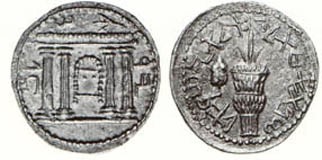
Bar Kochba, silver seal AD 132/133
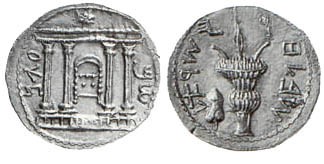
Bar Kochba, silver seal AD 133/134
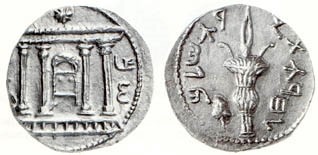
Bar Kochba, silver seal AD 134/135
Post-AD 70 history simply does not fit. Certainly Israel has not yet turned to Messiah, yet there are rulers in modern Israel equivalent to a king or prince. Therefore this cannot even refer to a period future to us. Even if Heschmeyer were to more correctly say that there have been no kings of Israel from AD 136 to the establishment of the modern state of Israel, he cannot isolate this couplet from the other two. During the same period there would be no prophecy (see comments above and below), still contradicting modern Romanist dogma.
Second, was Israel without a priest after AD 70? The answer is clearly "No." The Jews established priests. The following are two coins commemorating Eleazar as Priest:
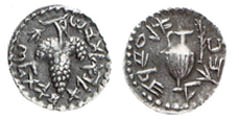
Eleazar the Priest, silver zuz AD 132/133
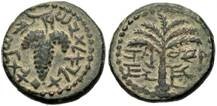
Eleazar the Priest, small bronze AD 132/133
Third, was Israel without a claimed prophet after AD 70? There were many false prophets. Shirokov and Lizorkin-Eyzenberg say, "According to the Palestinian Talmud, Akiva prophetically proclaimed Simon Bar Kosiba as Bar Kochba, the son of the star and Messiah, quoting Num 24:17, 'a star (כּוֹכָב, kokhav) will come out of Jacob' (y. Ta'anit 4:6)."64 Obviously we reject their prophecies, but the third couplet excludes both true and false prophecy in Israel during the time period of verse 4. 400-5BC fits, but not any period since. But even if Heschmeyer were to change his argument to make it be fulfilled during the period between AD 136 and the establishment of the modern state of Israel, he would still have the problems that are noted above and below.
What about some other options that Heschmeyer does not mention?
Some Premillennialists believe that this means that Israel will have a restored temple and priesthood in the future, restored Kings, and restored Prophets, but in between AD 70 and this future restored temple there will be no royalty, no priesthood, and no prophetic revelation. This was already disproved with the Bar Kochba and Priest Eleazar evidence above.
Roman Catholics might be tempted to transfer the word "Israel" to the church, but that does not get them out of hot water. The "afterward" of verse 5 must mean that verse 4 occurs before the restored church of verse 5 appears. If verse 5 is after AD 70, then there could be no kings, priests, or prophets before AD 70 — something not historically true. But even if they take verses 4 and 5 as contemporaneously happening after AD 70, then the absence of kings, priests, and prophets (v. 4) undermines the Roman Catholic view of a Roman Catholic priesthood after AD 70 and ongoing revelation through councils, mystics, and an infallible pope after AD 70. It also ignores the word "Afterwards."
But is my view any better? Heschmeyer wants to insist that the Teraphim must be good because:
In the context of Hosea 3:4, Hosea is clearly presenting it as bad that Israel is "without ephod or teraphim," not yet fully reconciled to God. So it hardly makes sense to say that the prophet is lamenting that Israel doesn't have her idols. Instead, the teraphim here are probably the Temple adornments, or even something related to the priest's own vestments.
So, just for the sake of argument, let's assume that Teraphim are good. They would still be parallel in some way with Ephod, and since Mr. Heschmeyer agrees that Kayser "might well be right on" seeing the three couplets as relating to King, Priest, and Prophet, let's rephrase the chart given above:
It's good that they won't need Kings or princes
It's good that they won't use sacrifices or sacred pillars
It's good that they won't need the Ephod or Teraphim (because of sufficiency of OT)
How one defines the terms can make the parallelism look "convoluted" or not. I still believe that my original exegesis does justice to the point, but this adaptation (if Teraphim is a positive form of revelation like the Ephod) also does justice to the same point. There was an absolute cutting off of good revelation (as my exegesis of Amos 8:11-14 shows in the next section). But if (as Heschmeyer believes) this is after AD 70, then good revelation will be absent from the church — something that Heschmeyer denies. He can't have his cake and eat it too.
Mr. Heschmeyer has apparently not read my book very carefully because he asserts:
Kayser captures none of that in his exegesis, in which it is God who separates Himself from Israel (but cutting off prophets for no apparent reason) and God who reunited Himself to Israel (through the Incarnation). As bizarre as this may be, Kayser's exegesis would seem to make God the adulteress, not Israel.
But is it wrong for God to separate Himself from an adulteress wife for a period of time after restoration? No. That does not make God the adulteress. Many commentators have pointed out that it would be normal procedure for Hosea to make his wife (who had become a prostitute prior to his purchasing her back) abstain from all sex (licit or illicit) for a period -- precisely the interpretation of verse 3 given by many of the scholars I have noted above. Hosea insists that she "not play the harlot" (sexual intercourse with a man other than her husband) and not "have a man" (literally not approach "to the husband" לְאִ֑ישׁ) and for Hosea to promise to not have sexual relations with her during this period of repentance and restoration ("so, too, will I be toward you"). This then parallels the Lord no longer providing revelation to Israel for many days and asking her to no longer seek any new revelation (whether from Him or from other gods). Thus verses 1-5 fit the historical situation below rather well:
- Israel was the adulteress cut off (exile) in 722 BC (symbolized by the woman loved by a lover in verse 1).
- Gomer then represents Israel restored to God in 537 BC (vv. 2-3).
- Verse 4 represents AD 400-5BC
- Verse 5 represents Christ beginning His kingdom and bringing His perfect work as King, Priest, and Prophet.
Thus, my book is correct in saying that there is an intertestamental period in which there was no more prophetic revelation. It parallels Amos 8:11-14 (see below).
Heschmeyer's fifth argument — Kayser's exegesis of Amos 8:11-14 is not credible
Heschmeyer then attempts to tackle my argument from Amos 8:11-14, which says:
^11^ "Behold, the days are coming," says the Lord GOD, "That I will send a famine on the land, Not a famine of bread, Nor a thirst for water, But of hearing the words of the LORD. ^12^ They shall wander from sea to sea, And from north to east; They shall run to and fro, seeking the word of the LORD, But shall not find it. ^13^ "In that day the fair virgins And strong young men Shall faint from thirst. ^14^ Those who swear by the sin of Samaria, Who say, "As your god lives, O Dan!' And, 'As the way of Beersheba lives!' They shall fall and never rise again."
His first response is that this is a famine of preaching, not a famine of new revelation. He says:
When God speaks of a famine for His word, why would that mean a lack of new revelation? Through the prophet Zechariah, God says to the faithful of Zion "Let your hands be strong, you who in these days have been hearing these words from the mouth of the prophets" (Zech. 8:9), and they're contrasted with those who "made their hearts like adamant lest they should hear the law and the words which the Lord of hosts had sent by his Spirit through the former prophets" (Zech. 7:12). That's not about people receiving or not receiving new revelation. It's about what they do with the revelation that they've already received. Likewise, King Josiah gathered "all the people, both small and great; and he read in their hearing all the words of the book of the covenant which had been found in the house of the Lord" (2 Kings 23:2), calling the people back to their ancestral faith. And when God gave the people manna to remind them that "man does not live by bread alone, but that man lives by everything that proceeds out of the mouth of the Lord" (Deut. 8:3), He wasn't telling them to demand a new prophetic revelation every day. In Kayser's view, the famine "of hearing the words of the Lord" is because the people have the Scriptures, but no new revelation.
But his quoted verses prove my point, not his. In Zechariah 8:9, what words are they hearing? They are not hearing revelation already written in Holy Scripture. Instead, they are "hearing these words from the mouth of the prophets." The prophets were giving new revelation to the post-exilic community. Likewise, Zechariah 7:12 isn't speaking of Zechariah's contemporaries having hard hearts against the writings of the former prophets. It is explaining why the pre-exilic community had been exiled. It was because they had refused to listen to the former prophets as they spoke God's law and God's judgments against them. Because they hardened their hearts, God says, "I scattered them with a whirlwind among all the nations which they had not known. Thus the land became desolate after them..." (v. 14). Context dictates the meaning.
I agree that 2 Kings 23:2 does speak of the people hearing God's written Word read. But who did the reading? Not the prophets, but the king.
But just for the sake of the argument, let's assume that Heschmeyer is correct in his assertion. Was there any famine of preaching during the time of the Maccabees and beyond? Absolutely not. By inspiration the apostles gave their Spirit-guided Jerusalem council letter. In that letter they state:
For Moses has had throughout many generations those who preach him in every city, being read in the synagogues every Sabbath. (Acts 15:21)
It appears that there were no generations lacking the weekly preaching of God's Word every Sabbath. In stark contrast, Amos speaks of a period of time during which anyone could travel from sea to sea, from north to east, and run to and fro, "seeking the word of the LORD, but shall not find it." (v. 12). It is hard to see how that could be said of the preaching of God's Word. I have read through the Intertestamental literature, and every period of time from 400 BC to 5 AD has had faithful Jews who preached God's Word. Despite persecution they preached God's word in season and out of season. Even though kings sought to destroy the written word of God, they were not able to do so. In contrast, that same Intertestamental literature speaks of prophets having ceased: "Grievous trouble came upon Israel such as had not occurred from the time that prophets ceased to appear among them" (1 Macc. 9:27). This quote shows that Heschmeyer's so-called canonical book of 1 Maccabees contradicts his viewpoint! Even the heretical Second Apocalypse of Baruch denies that prophecy continued: "Our fathers in former times and former generations had helpers, righteous prophets, and holy men. . . . But now, the righteous have been assembled, and the prophets are sleeping" (2 Apocalypse of Baruch 85:1, 3). The Talmud itself reflects mainstream Judaism, yet it claims prophecy has ceased: "From the time that the last prophets, Haggai, Zechariah, and Malachi died, the Holy Spirit was withdrawn from Israel." (b. Sanh. 11a; see also b. Yoma 9b, 48b); b. Soṭa 48b), 48b, 9.13y; Soṭa 9.13; t. Soṭa 13.3; Cant. Rab. 8:11). My book gives much more historical evidence that fits my exegesis.
Next Heschmeyer seeks to refute my claim that Amos prophesied about the intertestamental period. He says:
So what reasons do Kayser give to accept the idea that Amos 8 is a prophecy about the period from 400 B.C. to 5 B.C.? That "[Amos] 8:1-10 is 607 BC and 8:11-12 is after 607 BC," and that "Samaria and the tribe of Dan were both still in existence" (p. 98). To say that these arguments are unpersuasive is too mild. They're outright bizarre. First of all, the tribe of Dan didn't exist at any point between 607 B.C. and 5 B.C. Dan was one of the ten northern tribes that broke away from Judea during Jeroboam's Rebellion after the death of King Solomon (1 Kings 11:29-38). This northern kingdom became known as Samarian, and in 733 B.C., "the king of Assyria captured Samaria, and he carried the Israelites away to Assyria, and placed them in Halah, and on the Habor, the river of Gozan, and in the cities of the Medes" (2 Kings 17:6). There's no mention in the Bible as to what happened to most of these exiles, or whether they are related in any way other than name to the Samaritans who lived in the land at the time of Christ (and down to today). For this reason, these ten tribes are often called the "lost tribes" of Israel:
In postbiblical tradition, the deported northern Israelites are often referred to as the "ten lost tribes." Given the lack of documentation relating to the fate of the northern exiles, later writers referred to those dispersed to obscure locations with the (former) Assyrian empire as "lost." The number "ten" is given, because this number represented the traditional number of northern tribes (e.g., 1 Kgs 11:29-38). In the case of the later exiles of Judahites to Babylon (ca. 598 and 586 BCE), there is significant historical literature pertaining to the return or, more accurately, the returns of some Judahites back to their homeland in the centuries that followed. With one important exception, referring to the resettlement of exiles from Manasseh and Ephraim in Jerusalem (1 Chr 9:3; Knoppers 200b), there are no comparable biblical accounts of the exiled residents of the former northern kingdom.
The tribe of Dan was wiped off the map permanently during the lifetime of the prophet Amos, so it would be a mistake to take his line "As thy god lives, O Dan" (Amos 8:14) to be some kind of unfulfilled promise that the tribe would geographically exist at some later date. It didn't, as a map of Israel at the time of Christ reveals. That's what's so peculiar about Kayser's argument: a major part of the argument hinges on what appears to be a pretty basic geographical and historical error, akin to saying that something must have happened in 2016 rather than 2017 because the Thirteen Colonies were still around.
But getting the history of Israel wrong is understandable: a lot of Christians are fuzzy on the Twelve Tribes. What's worse is Kayser's claim that Amos 8:1-10 is describing 607 B.C., which (for some reason) makes Amos 8:11-12 about 400-5 B.C. The reason that's troubling is that, in his eagerness to find something that will disprove the Deuterocanonical Books, he's butchering a pretty explicit Messianic prophecy. Here's the Amos prophecy back in its proper context, Amos 8:9-12:
"And on that day," says the Lord God, "I will make the sun go down at noon, and darken the earth in broad daylight. I will turn your feasts into mourning, and all your songs into lamentation; I will bring sackcloth upon all loins, and baldness on every head; I will make it like the mourning for an only son, and the end of it like a bitter day.
"Behold, the days are coming," says the Lord God, "when I will send a famine on the land; not a famine of bread, nor a thirst for water, but of hearing the words of the Lord. They shall wander from sea to sea, and from north to east; they shall run to and fro, to seek the word of the Lord, but they shall not find it.
Compare that to St. Luke's account of the Crucifixion of Christ: "It was now about the sixth hour, and there was darkness over the whole land until the ninth hour, while the sun's light failed; and the curtain of the temple was torn in two" (Luke 23:44-45). The "sixth hour" is noon, so Luke could hardly be clearer in spelling this one out. He's saying that Good Friday is the fulfillment of Amos 8.
But it is Heschmeyer who is guilty of historical error. Ezekiel predicted the restoration of Dan to the land of Israel, saying of this post-exilic land that "there shall be one section for Dan from its east to its west side; by the border of Dan" (Ezek. 48:1). It goes on to lay out the post-exilic land for each tribe, and tells that community to name the twelve gates of the city of Jerusalem after each tribe, including "one gate for Dan" (Ezek. 48:32). That prophecy about restoration to the land is clearly a prophecy related to a period after the Babylonian exile, and Dan is included. Yet Heschmeyer claims that Dan no longer existed when Ezekiel wrote about Dan!! Later Scripture categorically says that all twelve tribes returned to Israel with Ezra and Nehemiah (Ezra 6:16,17; 7:13; 8:35; 10:5; Neh. 11:34; 12:47) and continued to be in existence at the time of Jesus (Luke 2:36; Acts 1:39) and of James (James 1:1). Paul himself says, "To this promise our twelve tribes, earnestly serving God night and day, hope to attain" (Acts 26:7). Are the Apostle Paul's words "outright bizarre" (as Heschmeyer worded it)? Paul obviously believed the twelve tribes to still be in existence in his day. But as I pointed out in my book, no tribal distinctions exist after AD 70.
But let's dig into the timing issues in more detail. Heschmeyer fails to interact with the other timing clues that I gave in the book. There is a sequence in the chapters, with chapter 7 dealing with the exile of the northern tribes, chapter 8 dealing with the exile of Judah, and chapter 9 dealing with the exile of Israel in AD 70. Each of those sections have clear internal clues as to that sequence.
And he also ignores the timing clues in 8:1-10. The immediate context of verse 9 necessitates that it be fulfilled in Amos' imminent future. For example, the basket of summer fruits (verses 1-2) shows the imminence of the judgment he is pronouncing: "The end has come upon My people Israel; I will not pass by them anymore." He then addresses the temple standing before him (8:3) and says that it is this current temple that will soon to be destroyed (8:2-3) because of the current sins being committed there (verses 5-10). This is not a future temple and people in Christ's day that will be judged, but the people Amos was addressing and the temple he was seeing. The word "end" that brackets this pericope (vv. 2,10) is clearly the end of the first temple, not the second temple of Christ's time. Given this context, let's quote the whole of verse 9:
"And it shall come to pass in that day," says the Lord GOD, "That I will make the sun go down at noon, And I will darken the earth in broad daylight;"
First, note the clear time-reference, "it shall come to pass in that day." Which day has he been talking about in the previous verses? The day that the temple will end. It is arbitrary to yank this verse out of context and place it hundreds of years into the future.
Second, to assume that a solar eclipse has to refer to the time of Christ when there are other clear solar eclipses in the Bible (Is. 13:10; Ezek. 32:7; Joel 2:10,31; 3:15) is a startlingly insensitive way to approach the text. It is more akin to word association or image association than it is to exegesis. But it is even more startling that he could say that this is butchering a pretty explicit Messianic prophecy. Let me quote him at length on this point:
What's worse is Kayser's [sic] claim that Amos 8:1-10 is describing 607 B.C., which (for some reason) makes Amos 8:11-12 about 400 -- 5 B.C. The reason that's troubling is that, in his eagerness to find something that will disprove the Deuterocanonical Books, he's butchering a pretty explicit Messianic prophecy. Here's the Amos prophecy back in its proper context, Amos 8:9-12:
"And on that day," says the Lord God, "I will make the sun go down at noon, and darken the earth in broad daylight. I will turn your feasts into mourning, and all your songs into lamentation; I will bring sackcloth upon all loins, and baldness on every head; I will make it like the mourning for an only son, and the end of it like a bitter day.
"Behold, the days are coming," says the Lord God, "when I will send a famine on the land; not a famine of bread, nor a thirst for water, but of hearing the words of the Lord. They shall wander from sea to sea, and from north to east; they shall run to and fro, to seek the word of the Lord, but they shall not find it."
Compare that to St. Luke's account of the Crucifixion of Christ: "It was now about the sixth hour, and there was darkness over the whole land until the ninth hour, while the sun's light failed; and the curtain of the temple was torn in two" (Luke 23:44-45). The "sixth hour" is noon, so Luke could hardly be clearer in spelling this one out. He's saying that Good Friday is the fulfillment of Amos 8.
While Kayser may have missed the obvious Christological meaning, the earliest Christians didn't. St. Irenaeus of Lyons, writing in 180 A.D., explained that Amos 8:9-10 "plainly announced that obscuration of the sun which at the time of His crucifixion took place from the sixth hour onwards, and that after this event, those days which were their festivals according to the law, and their songs, should be changed into grief and lamentation when they were handed over to the Gentiles." In other words, the famine of the word wasn't some arbitrary caprice on the part of God. The people who rejected the Word of God, the Bread of Life, found themselves cut off from God, in a famine for the Word, and then quickly in a literal exile: the Diaspora of 70 A.D. Irenaeus connects these events to Jeremiah 15, in which God says to Jerusalem "you have rejected me" and warns that "she who bore seven has languished; she has swooned away; her sun went down while it was yet day; she has been shamed and disgraced. And the rest of them I will give to the sword before their enemies, says the Lord" (Jer. 15:6, 9). Similar observations were made by Tertullian (155-240 A.D.), St. Cyprian (200-258 A.D.), Lactantius (250-325 A.D.), and countless others.
In other words, Kayser's error in interpreting Amos 8 is exactly the same as his error in interpreting Hosea 3. Both passages are about Jesus Christ, and the consequences for Israel of rejecting Him, and that's how the early Christians understood both passages. Ignorant of, or indifferent to, two thousand years of clear Scriptural interpretation, Kayser reinterprets these passages to be, not about the rejection of Christ, but of God arbitrarily refusing to give His people prophets. Not only does nothing in the text require such an interpretation, but to support such an interpretation, Kayser has to reduce Hosea 3 to unintelligibility, while rediscovering the lost tribe of Dan to make his Amos 8 interpretation work.
I find it amusing that he quotes three church fathers and alludes to "countless others" who applied verses 9-10 to the crucifixion. I own all the church fathers too, and I can assure you that there are not countless church fathers that agree with Heschmeyer. He then pretends that his interpretation was the universal interpretation of the "early church" and of "two thousand years of clear Scriptural interpretation" and mocks the idea that this could be applied to pre-Christian history. What he fails to tell the reader is that many of these church fathers held to a "double interpretation" (as Cyril of Alexandria worded it). They held that the immediate fulfillment of verses 9-10 is just as I gave it and then they give a further application to Jesus. For example, Cyril said (bold text is mine):
So come now, considering both meanings, let us state what is likely. We shall first detail the sequence of the passage, and then proceed to apply the sense of the words to the interpretation about Christ. On that day, then, when the end comes upon all of Samaria like a river of Egypt, a terrible and profound darkness will descend on all its inhabitants, so to speak, like sunset, though it is midday. We do not claim that the light of the sun really set; rather, it was the disaster of war that came upon the inhabitants of Samaria like darkness*; an overwhelming grief disturbs the mind (518) when it disappears, the heart is darkened by a fate beyond hope and expectation, and the severity of the calamities produces a kind of mist and gloom in the hearts of those affected.
They will therefore see darkness, he says, even if the sun is still at midday. Those in former times, on the other hand, who celebrated feasts in splendid style, always making use of strings, lyres, and the most melodious songs, will desist from such diversions and instead mock them, turning their songs into lamentations, adopting the weeds of mourning, namely, sackcloth and baldness. Now, it was a shameful thing to go baldheaded; the divinely inspired Job, for instance, cut his hair when his children perished. The text says, I shall make Jacob like mourning for a beloved; that is to say, those who see him in this condition will grieve over him as a mother or father over the loss of an only child who is beloved. And those with him like a day of sorrow: those from neighboring Judah and Benjamin who worshiped idols along with Ephraim and were with him in this respect, will be found to have a day of sorrow and suffer pangs, as it were, singing songs of troubles, grief, and hardship. Sennacherib had ravaged Samaria, remember, and taken all their cities; then he sent the Rabshakeh from Lachish to Jerusalem, where he threatened a dire fate to those on the wall. He so shattered the indifference of the residents of Jerusalem that they immediately expected to perish along with the Samaritans. Then it was that King Hezekiah in deep depression sent someone to the prophet Isaiah with the words, "Today is a day of tribulation, reproach, reproof, and (519) wrath, because the pregnant woman is suffering birth pangs and has no strength to give birth." He therefore speaks of a day of sorrow as though of the pangs and depression of childbirth. They were thus in a day of sorrow, the residents of Jerusalem who expected to perish, following Ephraim in the practice of idolatry.
While this is relevant and applicable, as I said, to those at that time who provoked the Lord of all against themselves, you could also apply it no less to those who offended Emmanuel himself at the time of the Incarnation. They were the ones, in fact, who oppress the needy in the morning, that is, those who were reluctant to choose to live a lawful life, who had no other concern than to undermine justice, and presumed to set at naught what had been clearly determined by the divine commandments and to oppress consistently any weaker people they chose. [etc.]"65
The point is, Cyril saw the primary fulfillment being in Amos' imminent future, but since the Jews of Christ's day acted in a similar manner to the Jews in Amos' day, he makes a secondary application to the time of Jesus. If Cyril saw a double fulfillment of the prophecy, I would disagree with his hermeneutics. But if he was merely applying the meaning of the text to Christ's day by way of secondary application, that is good preaching. But that is a far cry from saying that the text has nothing to do with Amos' day. He has slandered Cyril of Alexandria when he claims that seeing the primary fulfillment of the passage as I did "has to reduce Hosea 3 to unintelligibility." The context absolutely necessitates that Amos was prophesying about an imminent destruction of the first temple, not the second temple.
Jerome actually saw a triple fulfillment. He saw the primary (or first) fulfillment being the Assyrian captivity, the second being the darkness when Jesus was on the cross, and the third being the darkness filling all things when Vespasian and Titus conquered Jerusalem in AD 70. Let me quote him at length as well:
He indicates that that day is the day of captivity when each people will be led to the Assyrians and Chaldeans. Due to the extent of the people's sadness, the sun will set "at midday." And while there is the clear light for all, darkness will fill everything when their festivals and all their songs were turned into mourning and lamentation. They clothed themselves with goat hair on each of their backs or on their loins, and according to the custom of ancient mourners they had baldness on their heads, which we read that also Job did because of the deaths of his children. And such will be the extent of their mourning and sadness that it surpasses the grief of an only child dying or of a mother's dearest, and all things are filled with lamentation and bitterness.
We can also understand this passage in connection with the passion of the Lord, when the sun withdrew its rays at the sixth hour and did not dare to look on its Lord as he hung on the cross; when, as darkness was filling all things and Vespasian and Titus were conquering, their festivities and songs were turned into mourning and lamentation; when all things were filled tears, and repentance, and goat hair, and the heads that earlier had been adorned with flowing hair of the Nazirites, which were growing long hair for the Lord, now were bald. Then the firstborn son of God, the people of Israel, who had laid hands on the only begotten and the one who was truly the Son of God, was handed over to eternal mourning. And the latter end thereof, or "those who were with him," were filled with bitterness.
Now, therefore, while those who rejected the sun of justice have darkness, we who were sitting in darkness and in the shadow of death have seen a great light, and every festival of theirs has been transferred to the mysteries of the church, so that we are singing praises to the Lord while they are weeping. They are girding themselves with cords and goat hair for a belt; to us, along with the apostles, it is said: "Let your loins be girded and your lamps be burning in your hands." We have been girded with the truth of Christ, fulfilling that which is written: "Stand, having girded your loins with truth."66
But I will point out that it is rather hypocritical of Heschmeyer to claim that I have engaged in "Arguments from Authority" when I quote scholars who agree with my exegesis, when he is doing the same thing here. Of the 158 commentaries that I own on Amos, I could only find eight ancient ones that sided with Heschmeyer. It is simply not true that there have been 2000 years of consistent interpretation that overthrows mine. I'll give a sampling of authors from a wide spectrum of theological persuasion who feel compelled by the evidence to say that verse 9 does not refer to the Messianic age, but to a time imminent to Amos:
- Smith and Page say, "Two solar eclipses had been visible in the region, on February 9, 784 b.c. and on June 15, 763 b.c. An eclipse suddenly transformed things into their opposite: sundown at midday, darkness in broad daylight. The calamity awaiting Israel would come with awesome dread and startling suddenness."67
- Carrol says, "A partial eclipse occurred on June 16, 763."68
- Hubbard says, "Two such eclipses have been calculated to have occurred in Amos' lifetime: one in 784 bc, the other in 763 bc."69
- Bergant and Karris say, "Verse 9 of chapter 8 may be alluding to an eclipse of the sun on June 15, 763; there was another total eclipse in 784."70
- MacArthur says, "Probably referring to the total eclipse of the sun ca. 763 b.c. as a picture of God's coming judgment."71
- Commenting on 8:1-10, Dyer says, "In this play on words Amos saw "ripe" fruit because the time was ripe for God to judge His people. Just as the final fruit of the summer signaled the end of the harvest season, so God's "end" for Israel was now at hand."72
- Phillips says, "Amos foretold an eclipse. This verse, which is a parable as well as a prophecy, indicated that instead of gradually declining into insignificance, the sun of Israel would plunge into darkness when it was at its meridian. And so it did. After Jeroboam II died, one military coup succeeded another, and the shadow of the eclipse began to move relentlessly across the face of Israel's sun. When Pekah ascended the bloodstained throne, he brought some order back to government. However, he turned his hand against Judah by joining with Rezin (king of Syria) in the Syro-Ephraimitic alliance so that he could eliminate the royal Davidic line (Isaiah 7:6). Ahaz (king of Judah) in turn appealed to Assyria for help. At once the terrible armies of Tiglath-pileser moved south and subdued and deported the two-and-a-half tribes east of the Jordan. Hoshea murdered Pekah, and the Assyrians returned under Shalmaneser. The eclipse was complete. Amos described the anguish that would accompany the Assyrian invasions in Amos 8:10 and something worse than natural and national disasters in 8:11--12."73
- Mann says, "This vision is the fourth of five (see exegesis for last Sunday, pp. 221--25) that conclude with God's relentless judgment against the northern realm of Israel in the early eighth century BCE. The "end" will be national destruction and exile (7:17; 9:4), from which none shall escape (9:1)."74
- McComiskey says, "The destruction to come on Samaria will cause bitter mourning."75
- House says, "By Amos's time God has endured Israelite idolatry for nearly two centuries (c. 930-760 b.c.). Repentance has not materialized (4:6-13), yet still the Lord relents. The third vision, however, is of God using a plumbline to measure Israel for destruction (7:7--9). Now God will not wait. Why? Because the people persist in improper worship (7:9) and because their religious leaders refuse to accept Amos's words as coming from the Lord (7:10--17). Instead they choose political approval."76
- Adeyemo says, "But the prophecy was fulfilled by an eclipse that took place in 784 bc, a few years after this prophecy, in the year of the death of Jeroboam II. This particular eclipse was said to have reached its height in Jerusalem just before midday. There was also a second eclipse several years after this first one."77
- Smith says, "But Amos is not predicting the final end of the world as Isaiah 24 does; rather, he is predicting the approaching Day of the Lord for Israel when the religious, political, and social status quo will end (fulfilled in 722 b.c., when the Assyrians captured Samaria)."78
- "Archbishop Usher refers the prophecy to an eclipse of the sun in the feast of Pentecost, 791 b.c.; the feast of tabernacles, 771 b.c.; and the passover, 771 b.c."79
- Pusey says, "Tiglath-pileser came upon Pekah and carried off the tribes beyond Jordan. Pekah's sun set, and all was night with no dawn. Shortly after, Pekah himself was murdered by Hoshea, as he had himself murdered Pekahiah. After an anarchy of nine years, Hoshea established himself on the throne; the nine remaining years were spent in the last convulsive efforts of an expiring monarchy, subdual to Shalmaneser, rebellious alliance with So, King of Egypt, a three years' siege, and the lamp went out."80
- Longacre says, "In the first place it is quite clear that Amos is not thinking of what people to-day mean by the end of the world. He is referring to the punishments that shall come upon the people and he evidently regards these punishments as near at hand."81
- Poole says, "The sun; literally, say some, but erroneously; by sun I understand rather the settled state of their prosperity under their present government in the house of Jehu; or it may refer particularly to their king and court, which Jeroboam at his death left like the sun at noon in the height of their glory, as all know who know the history of those times. To go down at noon; so Israel's sun did as at noon set under the dark cloud of home-bred conspiracies and civil wars by Shallum, Menahem, Pekah, and Hoshea, till the midnight darkness drew on by Pul, Tiglath-pileser, and Shalmaneser. I will darken; bring a thick cloud of troubles and afflictions. The earth; the common people, the whole body of the nation; so the sun speaks the royalty, nobility, and great ones of this kingdom, by an allusion well known in Scripture, and the earth speaks the common sort of people; and all are here threatened. In the clear day; when they did think (as in Jeroboam's time) all was safe, sure, and well settled, far from the night of sorrow and trouble, then will God bring all this he threateneth upon them."82
If, as Heschmeyer claims, my interpretation is "outright bizarre" and a "butchering" of the text, then he has to relegate over 100 scholarly commentators to this irrationality.
Heschmeyer goes on to summarize what he thinks he has proved thus far in his essay:
At this point, we've seen that Kayser's key arguments are false. When he claimed that it "was an axiom among Jews that the Scripture foretold the cessation of all prophecy from 400 BC until the Messiah should arise as the Great Prophet," what he really meant seems to have been more like "my private interpretation of Amos 8 and Hosea 3, contradicting all of the ancient Jewish and Christian sources, lets me imagine Scriptural support for 400 years of divine silence." But nevertheless, you might be wondering: is there a Scriptural argument against the theory 400 years of divine silence? The short answer: there is, but you're probably exhausted from reading this long, so I'll keep it brief.
As can be seen by my quotes in this paper, it is not "my private interpretation of Amos 8 and Hosea 3, contradicting all of the ancient Jewish and Christian sources." My approach to both texts involves standard exegesis shared by many scholars. While I can understand differences of opinion people might have on both texts, I do not understand the bombastic character assassination and misrepresentation that Heschmeyer has been engaging in. Let's deal with the facts.
Heschmeyer's last arguments are attempting to put the nail in the coffin on the subject of 400 years of silence
Heschmeyer seeks to show that there must have been a continuation of non-stop prophets from 400 BC until the time of Christ because John was a prophet comparable to Old Testament prophets and indeed Matthew 11:11-14 says that "all the prophets and the law prophesied until John" implying that John was just part of a long uninterrupted succession of prophets from Malachi to John, and that prophecy has never stopped. If Heschmeyer could prove this point, he would have made a significant argument. But my book has already accounted for the sudden rise of prophets (like Simeon and Anna) with the coming of Christ. This coming of prophets had been prophesied in the Old Testament and was anticipated by the Jews. My book demonstrates that it is precisely because the Old Testament gave predictions of the approximate time that the Messiah would arise in Israel that the intense Judaistic messianism arose in the first century AD. There is nothing in the last section of Heschmeyer's review that in any way contradicts the thesis presented in my book — with one possible exception: Matthew 11:13. But even the coming of John the Baptist was explicitly prophesied in Malachi 4. But let me quote the essence of Heschmeyer's last argument. He says:
Yet there is a sense in which John is an Old Covenant prophet, as Jesus said (Matt. 11:11-14):
Truly, I say to you, among those born of women there has risen no one greater than John the Baptist; yet he who is least in the kingdom of heaven is greater than he. From the days of John the Baptist until now the kingdom of heaven has suffered violence, and men of violence take it by force. For all the prophets and the law prophesied until John; and if you are willing to accept it, he is Elijah who is to come.
When Jesus says that "all the prophets and the law prophesied until John," He's declaring Old Covenant revelation closed ... with John the Baptist. Things don't stop suddenly and for no apparent reason in 400 B.C. They continue on until John, and they end then only because there's nothing more to prepare. On one side is the Law and the Prophets, up until John. On the other side is Jesus and the Kingdom.
If you think of "Old Covenant" as "Old Testament," that's probably confusing. John's in the wrong half of the book! And what's more, he never wrote any Scripture. Throughout this piece, I've been working with Kayser's assumption (ultimately, Josephus' assumption) about the relationship between prophets and the writing of the books of the Bible. But it's worth at least noting that some of the greatest Prophets in the Old Testament never wrote a word of Scripture. For instance, at the Transfiguration, we see Moses and Elijah, the embodiment (so to speak) of the Law and the Prophets, respectively. Yet the one associated with the "Prophets" isn't the one associated with the writing of Scripture. So it's not so strange that Jesus would see the revelation of the Old Covenant as continuing on, unbroken, right up until His own arrival.
Heschmeyer's interpretation of Matthew 11:13 ("For all the prophets and the law prophesied until John") makes sense of the passage on the surface, but there are things that militate against that particular interpretation:
- First, it is not simply "prophets" who prophesied until John. The grammar necessitates that "the law" also prophesied until John. If "the law" is a reference to the Pentateuch (the normal way of taking that phrase in first century thinking), then one has to account for the word "until" in a way that does not mean that the Pentateuch was being written over a period of 2000 years and didn't get finished until John came onto the scene. His interpretation of "until" necessitates such a ludicrous conclusion. But the Greek word ἕως can have a range of meaning, including "marker of order in a series," "marker of limit reached [as in the next word referring to the last one]", etc.83 Thayer's dictionary actually lists this verse together with Matthew 1:17 and Luke 16:16 -- both of which allow for a large gap in the series.
- The above conclusion is strengthened by the fact that the order given is not "the law and the prophets," but "the prophets and the law," making the law the closest antecedent to "prophesied." The law was thousands of years removed from John as were many of the other prophets of the Old Testament period.
- This is further strengthened by the fact that "prophets" is modified by "all" -- it was "all the prophets... prophesied until John." But no one would say that every prophet who has ever lived continued to be alive and continued to prophesy until John came on the scene. Therefore, there must be another meaning of the clause that can account for dead prophets whose prophecies were never recorded in Scripture prophesying until John.
- This is further strengthened by the fact that it wasn't prophesying in general that was happening, but prophesying of "the prophets" (οἱ προφῆται). John appears to be the last of the old prophets like Moses (as Luke 16:16 affirms).
Heschmeyer may believe that his interpretation is the only and obvious one, but (as Douglas Hare worded it), "The interpretations of verses 12-13 are legion."84 Some of this may be due to the fact that the Greek word ἕως can have a range of meaning. Some of the interpretations revolve around different definitions of the word προφητεύω. Some of the differences may be due to Matthew's unusual word order. Let me list some of the alternative interpretations that scholars have given:
- Keener: "Jewish people sometimes summarized the Bible as 'the Law and the Prophets'; many of them believed that after the biblical prophets the prophetic voice was muted until the messianic time. John thus introduces the messianic era."85
- Johnson: "Prophesied. All these books, the writings of prophets, pointed forward to Jesus; and even the ceremonies of the law were symbols of the New Dispensation. But at the same time, they only prophesied of a thing in the far future. John did not prophesy of it as future; he proclaimed it as actually present. Hence the effect of his ministry. Until John. Here, again, the ministry of John is placed in the New Dispensation."86
- Gill: "For all the prophets and the law prophesied until John. These words are to be considered in connexion with ver. 11 and are a further proof of John's being greater than any of the prophets; because all the inspired writers and prophets, who were before him, prophesied of the Messiah as to come; and either spoke of him in obscure terms, or represented him under dark shadows and figures: whereas John spake of him as already come, and in plain terms, and directed to his very person; and since his time, there have been no prophecies concerning the Messiah and his kingdom; vision and prophecy are now sealed up; all which are acknowledged by the Jews themselves, who say, כל הנביאיﬦ כולז לא נתנבאו אלא לימות המשיח, all the prophets did not prophesy but to, or of the days of the Messiah. This was the subject, and these the limits of their prophecies; for they own, that 'from the day that the temple was destroyed, בטילה נבואה מן הנביאי, prophecy was taken away from the prophets.' Since that time, they confess they have had no prophet, and that they are not able to observe their signs."87
- Hendriksen: "'All the prophets and the law' indicates 'the entire Old Testament,' as far as the prophets that wrote books are concerned ending with Malachi, in whose book the coming of Christ and of his herald was predicted. Thereupon prophecy was silent for more than four hundred years. After that came the fulfilment of prophecy in Jesus Christ, but (chronologically speaking) first of all in John the Baptist. In him, accordingly, prophecy was beginning to be fulfilled. It was he who tied together the old and the new dispensation. At least equally important, it was he whose inspired exhortation, if obeyed, would solve the problem of the generation gap, for by means of faith in the Christ whom he proclaimed the hearts of the fathers were turned to the children, and the hearts of the children to their fathers (Mal. 4:5, 6). This John the Baptist, preacher of repentance and faith, was accordingly the Elijah who was to come."88
- Weber: "The Prophets and the Law is a variation on a phrase used often in the New Testament to represent the whole of the Old Testament. There is debate about whether John himself belonged to the old era or the new. Actually, John could be considered the last martyr among the prophets of old, and the first martyr of the New Testament order."89
- Louw & Nida: "προφητεύω – to speak under the influence of divine inspiration, with or without reference to future events—'to prophesy, to make inspired utterances.'"90
- Evans: "To say that the Law prophesied is not strange in Judaism of late antiquity, for all of Scripture was viewed as in some sense prophetic (and Abraham, Moses, and other figures in the Pentateuch were regarded as prophets)."91
- Doriani: "The language of verse 13 is unusual; in Jesus' statement 'Prophets' precedes 'Law,' and both are said to prophesy, but the point is transparent. The whole OT prophesied until John, and he is the Elijah foretold by Malachi 3:1–3. He inaugurates the new covenant and the first phase of the day of the Lord, with Jesus at its center."92
- Turner: "All scriptural prophecy culminated in John, who fulfills the role of Elijah."93
- Bruner: "But the law and the prophets do their work of prophecy only 'until John.' Any OT prophecy that goes around, over, and even through, but still past John and Jesus, and into modern events is not prophecy but voodoo. The OT is not about the late great planet earth or 'the left behind'; it is all, only, and exclusively about the Messiah, come and coming, and only about him. This is the apostolic conviction in the verse before us, and no honor is done either to Scripture's prophecy or to Jesus' work by turning the OT into a cabalism giving keys to current events."94
- Olshausen, Ebrard, Wiesinger: "Next we inquire how the word προεφήτευσαν, prophesied, is to be explained. It might be understood: 'the prophetic agency continues until John—himself included.' But, in the first place, John himself was not properly a prophet in the Old Testament sense; he only bore witness of him who was now present, and invited to repentance; in the second place, moreover, prophesy continued even after John (Acts 11:28). It is, therefore, better to understand it of the prophecies themselves, and its meaning to be: 'with John the prophecies are fulfilled; they do not extend beyond him.' But this thought seems without foundation; inasmuch as so many prophetic oracles reach down to the establishment of the kingdom of God on earth, in the remotest future. Yet the words which follow in verse 14, compel us to decide in favour of this view; in them John is represented as Elijah, and this points to the end of all prophecy. (Mal. 4:5.) Hence, it is probable, that we must add this passage to the many other passages in which both according to the words of Christ, and those of the apostles, every thing appears consummated at their time. The explanation of these striking declarations lies simply in this, that up to the time of John the Baptist the time of prophesying continued, and with Christ commenced that of fulfilment. Ver. 14—As if for addition and confirmation, Christ subjoins, moreover, that this John was also the promised Elijah. As regards, in the first place, the notion of the appearance of Elijah, to which the words ὁ μέλλων ἔρχεσθαι, that was to come, refer, it rests on Mal. 4:5: הִנֵּה אָנֹכִי שֹׁלֵחַ לָכֶם אֵת אֵלְיָּה הַנָּבִיא, Behold I send Elijah, etc. The LXX. have very correctly referred these words to the Tishbite; and so likewise has Sirach 48:10; according to grammatical rules the word הַנָּבִיא requires a reference to a definite historical person. It might be made a question whether the reference to this definite person could not be explained figuratively by the ἐν πνεύματι καὶ δυνάμει Ἠλίου, in the spirit and power of Elijah, as in Luke 1:17. This would even appear more probable, if the New Testament itself did not furnish more exact information concerning it. According to Matth. 17:3, Moses and Elijah appeared as heavenly messengers to the Redeemer in his transfiguration; whereby the figurative explanation of that promise is rendered improbable. Striking, however, is the declaration in the passage before us, that John is Elijah; whereas he himself declares he is not. (John 1:21.) But even if the words 'if ye will receive it' did not indicate it, yet the whole connexion of this passage with the other passages which treat of Elijah, clearly shows that the Redeemer called him so only in a certain sense, viz., because he wrought in the spirit and power of Elijah, as Scripture says. (Luke 1:17.) Elijah the zealous preacher of repentance, is, as it were, the type of John. The question, however, is, whether we are to believe that that Old Testament prophecy has been entirely fulfilled in the appearance of John or of Elijah himself, at the time of Christ's transfiguration. We feel inclined to doubt this, when we read that the prophet Malachi (4:5), adds that Elijah will be sent, לִפְנִיִ בוֹא יוֹם יְהֹוָה הַגָדוֹל וְהַנּוֹרָה, before that great and terrible day, etc. It seems, therefore, not an improbable supposition, that this prophecy, although fulfilled in a certain sense, must be regarded as yet not wholly fulfilled. (Comp. remarks on Rev. 11:6.) As it is the nature of Old Testament prophecy that its subject may appear in a previous manifestation, without its import being thereby fully exhausted, so also here. The time of Christ was by no means the prophesied great day of the Lord; but that whole time which reached to the destruction of Jerusalem had a certain resemblance to the last days; and so it had also an element (John the Baptist) which prefigured the future appearance of Elijah. It is likely that, from such a train of ideas, the indefinite 'if ye will receive it' arose."95
- Gundry: "Here Jesus reverses the Old Testament order ("the Law and the Prophets") because it was a prophet—Malachi—who predicted the coming of Elijah (Malachi 4:5), and Jesus is about to equate John with Elijah. Malachi's prophecy of Elijah's coming is but one of many prophecies now being fulfilled, however. So Jesus adds 'all' to 'the Prophets.'"96
- Osborne: "The normal order ('law and prophets') has been reversed because the stress is on the prophetic function of the whole canon, with πάντες emphatic, 'all' the prophetic canon pointing to Jesus. The prophets as well as the law 'prophesied' about John but especially about Jesus the Messiah. So again John is the turning point between the ages. All before pointed to this moment, the arrival of Jesus the Messiah and the kingdom, and John was privileged to prepare the way."97
- Leiva-Merikakis: "Jesus is saying that John is the great dividing line between prophecy concerning the Kingdom and the actual arrival of the Kingdom. Note the verb tenses involved: 'Until John the Baptist, all the prophets and the Law have prophesied', while 'since the days of John the Baptist, the Kingdom of heaven is irrupting forcefully, and the forceful are seizing it.' Prophetic expectation has yielded to actual possession: the crucial transition between the two modes of relating to the divine economy is experienced by John in his person."98
- Nichol: "Prophesied until John. The meaning here is not readily apparent. Perhaps the context is the best guide to interpreting this verse. Christ has just acclaimed John as the greatest of all the prophets (see on v. 11). He was greatest in the sense that it was his privilege to announce the coming of Him to whom all the prophets had borne witness (see Luke 24:27; John 5:39, 46). In this sense the OT prophets all looked forward to the time of John and spoke of the Messiah who was then to appear (1 Peter 1:10, 11). Thus it could be said that the prophetic office of OT times reached a climax in John. Furthermore, the words of Matt. 11:14, that John was the one 'which was for to come,'' may well be considered explanatory of v. 13.99
- MacArthur: "Through the last words of the last prophet, God had said, 'Behold, I am going to send you Elijah the prophet before the coming of the great and terrible day of the Lord. And he will restore the hearts of the fathers to their children, and the hearts of the children to their fathers, lest I come and smite the land with a curse' (Mal. 4:5-6). This man would not be a reincarnated Elijah but another prophet much like Elijah. That Malachi's prophecy referred to John the Baptist and not to a literally-returned Elijah is made clear by the angel's message to Zechariah about John: 'It is he who will go as a forerunner before Him in the spirit and power of Elijah' (Luke 1:17); and John himself denied that he was actually Elijah (John 1:21). John was like Elijah—internally in 'spirit and power' and externally in rugged independence and nonconformity."100
- Chouinard: "The usual word order of 'the law and the prophets' (cf. 5:17; 7:12; 22:40) is reversed probably to stress the prophetic nature of the entire OT. As a key transitional figure, John's ministry signaled that the era of promise and expectation has reached its culmination in Jesus and the presence of God's kingdom. As such, John is the last and greatest of the OT prophets, since in him the 'law and prophets' find their climactic and definitive expression. He is indeed the Elijah who was to come (cf. 17:12; Mal 3:1-3; 4:5)."101
- Turner and Bock: "before John came, all the prophets and the law of Moses looked forward to this present time."102
But entirely apart from the meaning of Matthew 11:13, Heschmeyer fails to appreciate the elephant in the room — that these verses undermine the thesis that he started with: that prophesying does not have to be as authoritative as the Scripture. But this verse demonstrates my thesis that there is no distinction between the authority and character of oral prophecies and written prophecies. They both have the same authority as the Law (i.e., the Pentateuch) that prophesied God's words. John was greater than Moses and the Prophets only because he lived in the time of Christ as a herald of the kingdom. But once the kingdom came, even the least Christian in the kingdom was greater than John because he was actually in the kingdom. As Luke 16:16 words it, "The law and the prophets were until John. Since that time the kingdom of God has been preached, and everyone is pressing into it." I would also point the reader to the inconsistency between Heschmeyer's interpretation of Josephus (that there was only a gap in the succession of prophets — apparently no problem when reading Josephus) and his take on this verse (that there is no gap).
Having slogged through this much interaction with Heschmeyer and having seen as much misrepresentation of my book as he has given, I hope the reader will purchase my book and let it speak for itself. I have written this rebuttal simply because many people have had their confidence in the book poisoned. It is my hope that this answer will serve well to restore a confidence that if the weakest part of the book can be defended, the strongest parts of the book that Heschmeyer avoided will open up a whole new world of thinking and restore the reader to the historic position on the canon.
Footnotes
-
He says, "Proving any of that for even a few pages is laborious, and virtually impossible for an entire book. So what I've decided to do is to take just one section, show the problems with that, and then allow you to form an educated judgment of the quality of the rest of the book from this demonstration." ↩
-
Francis I. Andersen and David Noel Freedman, Hosea: A New Translation with Introduction and Commentary, vol. 24, Anchor Yale Bible (New Haven; London: Yale University Press, 2008), 291. ↩
-
Duane A. Garrett, Hosea, Joel, vol. 19A, The New American Commentary (Nashville: Broadman & Holman Publishers, 1997), 24. ↩
-
Francis I. Andersen and David Noel Freedman, Hosea: A New Translation with Introduction and Commentary, vol. 24, Anchor Yale Bible (New Haven; London: Yale University Press, 2008), 291. ↩
-
Laurie J. Braaten, "Review of Hosea by Ben Zvi, Ehud," Review of Biblical Literature, 2006. ↩
-
In Life 12:2, he says, "I...began to conduct myself according to the rules of the sect of the Pharisees." ↩
-
Joe Heschmeyer, “Did Prophecy End in 400 B.C.?” Shameless Popery, https://shamelesspopery.com/did-prophecy-end-in-400-b-c/. ↩
-
He calls him "the prophet Solomon." Theophilus of Antioch, "Theophilus to Autolycus," in Fathers of the Second Century: Hermas, Tatian, Athenagoras, Theophilus, and Clement of Alexandria (Entire), ed. Alexander Roberts, James Donaldson, and A. Cleveland Coxe, trans. Marcus Dods, vol. 2, The Ante-Nicene Fathers (Buffalo, NY: Christian Literature Company, 1885), 98. ↩
-
He says, "These are the words of Solomon... a most wise prophet." Gregory Thaumaturgus, Life and Works, ed. Thomas P. Halton, trans. Michael Slusser, vol. 98, The Fathers of the Church (Washington, DC: The Catholic University of America Press, 1998), 127. ↩
-
He said, "Therefore, in all likelihood, the Master spoke about the birth in the flesh through the prophet Solomon, when he [the latter] said, "Before the springs abounding with water came forth." As quoted by Eusebius of Caesarea, Against Marcellus and On Ecclesiastical Theology, trans. Kelley McCarthy Spoerl and Markus Vinzent, vol. 135, The Fathers of the Church (Washington, D.C.: The Catholic University of America Press, 2017), 292. ↩
-
Optatus says, "What you have mentioned is found in the prophet Solomon." Sever J. Voicu, ed., Apocrypha, Ancient Christian Commentary on Scripture (Downers Grove, IL: InterVarsity Press, 2010), 67. ↩
-
Hilary of Poitiers says, "The Prophet Solomon teaches us what this tree of Life is in his exhortation concerning Wisdom." Hilary of Poitiers, "Homilies on the Psalms," in St. Hilary of Poitiers, John of Damascus, ed. Philip Schaff and Henry Wace, trans. H. F. Stewart and William Sanday, vol. 9a, A Select Library of the Nicene and Post-Nicene Fathers of the Christian Church, Second Series (New York: Christian Literature Company, 1899), 239 ↩
-
Quoting from Song of Solomon 7:1-7, he says, "of whom the prophet says." Sever J. Voicu, ed., Apocrypha, Ancient Christian Commentary on Scripture (Downers Grove, IL: InterVarsity Press, 2010), 98. ↩
-
Quoting Solomon's Psalm 72, he says, "Scripture recalls this in the psalm in which the prophet speaks in a mysterious way of the king and of the king's son, saying, "He will endure as the sun, like the moon through all ages." Sever J. Voicu, ed., Apocrypha, Ancient Christian Commentary on Scripture (Downers Grove, IL: InterVarsity Press, 2010), 380. ↩
-
Lactantius, Lactantius: The Divine Institutes, Books I-VII, ed. Roy Joseph Deferrari, trans. Mary Francis McDonald, vol. 49, The Fathers of the Church (Washington, DC: The Catholic University of America Press, 1964), 510. ↩
-
For a couple of examples, see Theodoret of Cyrus, Commentary on the Psalms 1-72, trans. Robert C. Hill, vol. 101, The Fathers of the Church (Washington, DC: The Catholic University of America Press, 2000), 268-269, and 281. ↩
-
As quoted in J. M. Neale and R. F. Littledale, eds., A Commentary on the Psalms from Primitive and Mediaeval Writers: Psalm 39 to Psalm 80, vol. 2 (London; New York: Joseph Masters; Pott and Amery, 1868), 82-83. ↩
-
"For this, in fact, is what the Lord says by means of the prophet: 'Open your mouth, and I will fill it up.'" Sever J. Voicu, ed., Apocrypha, Ancient Christian Commentary on Scripture (Downers Grove, IL: InterVarsity Press, 2010), 286. ↩
-
He says, "In fact, those who 'go out weeping, scattering their seeds, will return rejoicing, carrying their sheaves.' How wisely the holy prophet teaches that the seeds of good works must be watered with rivers of tears!" Sever J. Voicu, ed., Apocrypha, Ancient Christian Commentary on Scripture (Downers Grove, IL: InterVarsity Press, 2010), 119, 349. ↩
-
Sever J. Voicu, ed., Apocrypha, Ancient Christian Commentary on Scripture (Downers Grove, IL: InterVarsity Press, 2010), 197. ↩
-
Céline Mangan, John F. Healey, and Peter S. Knobel, The Aramaic Bible: The Targum of Job and The Targum of Proverbs and The Targum of Qohelet, ed. Kevin Cathcart, Michael Maher, and Martin McNamara, vol. 3 (Collegeville, MN: The Liturgical Press, 1991), 5. ↩
-
John A. Davies, "'Discerning between Good and Evil': Solomon as a New Adam in 1 Kings," Westminster Theological Journal 73, no. 1 (2011): 44-47. ↩
-
Ibid., p. 44. ↩
-
R. K. Harrison, "Canon of the OT," in The International Standard Bible Encyclopedia, Revised, ed. Geoffrey W. Bromiley (Wm. B. Eerdmans, 1979-1988), 597-598. ↩
-
Josephus, The Life, Against Apion, ed. T. E. Page et al., trans. H. J. Thackeray, vol. I, The Loeb Classical Library (London; Cambridge, MA: William Heinemann Ltd; Harvard University Press, 1966), 177-181. ↩
-
Flavius Josephus and William Whiston, The Works of Josephus: Complete and Unabridged (Peabody, MA: Hendrickson, 1987). ↩
-
Emil Schürer, A History of the Jewish People in the Time of Jesus Christ, Second Division., vol. 4 (Edinburgh: T&T Clark, 1890), 149-150. ↩
-
Flavius Josephus and William Whiston, The Works of Josephus: Complete and Unabridged (Peabody: Hendrickson, 1987), 480. ↩
-
John P. Dickson, The Christ Files: How Historians Know What They Know about Jesus (Grand Rapids, MI: Zondervan, 2010), 43-45. ↩
-
Gretchen Ellis, "Prophecy," in The Lexham Bible Dictionary, ed. John D. Barry et al. (Bellingham, WA: Lexham Press, 2016). ↩
-
Benjamin D. Sommer, "Did Prophecy Cease? Evaluating a Reevaluation,".24%0a~The+Messiah+himself+) Journal of Biblical Literature 115 (1996): 36--37. ↩
-
Jonathan A. Goldstein, I Maccabees: A New Translation with Introduction and Commentary, vol. 41, Anchor Yale Bible (New Haven; London: Yale University Press, 2008), 376. ↩
-
Duane A. Garrett, Hosea, Joel, vol. 19A, The New American Commentary (Nashville: Broadman & Holman Publishers, 1997), 103. ↩
-
Derek Kidner, The Message of Hosea: Love to the Loveless, ed. J. Alec Motyer and Derek Tidball, The Bible Speaks Today (England: Inter-Varsity Press, 1976), 43. ↩
-
Hans Walter Wolff, Hosea: A Commentary on the Book of the Prophet Hosea, Hermeneia—a Critical and Historical Commentary on the Bible (Philadelphia: Fortress Press, 1974), 62. ↩
-
Douglas Stuart, Hosea-Jonah, vol. 31, Word Biblical Commentary (Dallas: Word, Incorporated, 1987), 67. ↩
-
Leon J. Wood, "Hosea,".+~Thus+the+people+will) in The Expositor's Bible Commentary: Daniel and the Minor Prophets, ed. Frank E. Gaebelein, vol. 7 (Grand Rapids, MI: Zondervan Publishing House, 1986), 183. ↩
-
Lloyd J. Ogilvie and Lloyd J. Ogilvie, Hosea, Joel, Amos, Obadiah, Jonah, vol. 22, The Preacher's Commentary Series (Nashville, TN: Thomas Nelson Inc, 1990), 72. ↩
-
G. Michael Butterworth, "Hosea," in New Bible Commentary: 21st Century Edition, ed. D. A. Carson et al., 4th ed. (Leicester, England; Downers Grove, IL: Inter-Varsity Press, 1994), 770. ↩
-
James B. Coffman, Commentary on the Minor Prophets: Hosea, Obadiah, and Micah, Revised Edition, vol. 2, The James Burton Coffman Commentaries (A. C. U. Press, 1986), Ho 3:4. ↩
-
David A. Hubbard, Hosea: An Introduction and Commentary, vol. 24, Tyndale Old Testament Commentaries (Downers Grove, IL: InterVarsity Press, 1989), 101--102. ↩
-
Marvin A. Sweeney, The Twelve Prophets & 2, ed. David W. Cotter, Jerome T. Walsh, and Chris Franke, vol. 1, Berit Olam Studies in Hebrew Narrative and Poetry (Collegeville, MN: The Liturgical Press, 2000), 40. ↩
-
Robert Jamieson, A. R. Fausset, and David Brown, Commentary Critical and Explanatory on the Whole Bible, vol. 1 (Oak Harbor, WA: Logos Research Systems, Inc., 1997), 652. ↩
-
H. D. M. Spence-Jones, ed., Hosea, The Pulpit Commentary (London; New York: Funk & Wagnalls Company, 1909), 87. ↩
-
Carl Friedrich Keil and Franz Delitzsch, Commentary on the Old Testament.+~The+prophet+mentions), vol. 10 (Peabody, MA: Hendrickson, 1996), 48. ↩
-
A. R. Fausset, A Commentary, Critical, Experimental, and Practical, on the Old and New Testaments: Jeremiah-Malachi, vol. IV (London; Glasgow: William Collins, Sons, & Company, Limited, n.d.), 468. ↩
-
Jeremiah Burroughs, "An Exposition of the Prophecy of Hosea," in An Exposition of the Prophecy of Hosea, ed. James Sherman (Edinburgh; London: James Nichol; James Nisbet & Co., 1863), 189. ↩
-
Adam Clarke, The Holy Bible with a Commentary and Critical Notes, New Edition, vol. 4 (Bellingham, WA: Faithlife Corporation, 2014), 632. ↩
-
William Drake, Notes Critical and Explanatory on the Prophecies of Jonah and Hosea (Cambridge: Macmillan & Co., 1853), 83. ↩
-
Arno C. Gaebelein, The Annotated Bible: Daniel to Malachi, vol. 5 (Bellingham, WA: Logos Bible Software, 2009), 59--60. ↩
-
F. Tilney Bassett, The Book of the Prophet Hosea: Commentary (London; Bath: W. Macintosh; R. C. Peach, 1869), 19. ↩
-
John Downame, Lectures upon the Foure First Chapters of the Prophecie of Hosea, vol. 2 (London: Felix Kyngston; William Welby, 1608), 30. ↩
-
Matthew Poole, Annotations upon the Holy Bible, vol. 2 (New York: Robert Carter and Brothers, 1853), 857. ↩
-
See my interpretation of verse 3 in its connection to verse 4 at the end of this section. ↩
-
James B. Coffman, Commentary on the Minor Prophets: Hosea, Obadiah, and Micah, Revised Edition, vol. 2, The James Burton Coffman Commentaries (A. C. U. Press, 1986), Ho 3:4. ↩
-
Francis I. Andersen and David Noel Freedman, Hosea: A New Translation with Introduction and Commentary, vol. 24, Anchor Yale Bible (New Haven; London: Yale University Press, 2008), 291. ↩
-
Duane A. Garrett, Hosea, Joel, vol. 19A, The New American Commentary (Nashville: Broadman & Holman Publishers, 1997), 24. ↩
-
Francis I. Andersen and David Noel Freedman, Hosea: A New Translation with Introduction and Commentary, vol. 24, Anchor Yale Bible (New Haven; London: Yale University Press, 2008), 291. ↩
-
Laurie J. Braaten, "Review of Hosea by Ben Zvi, Ehud," Review of Biblical Literature, 2006. ↩
-
The New American Commentary says, "The prophecy that they would seek "David their king" is messianic. The phrase does not mean simply that the Israelites would again submit to the Davidic monarchy and so undo Jeroboam's rebellion. Had that been the point, we would expect the text to say that they would return to the "house of David." Instead we see "David their king" set alongside of Yahweh as the one to whom the people return in pious fear. This "David" cannot be the historical king, who was long dead, but is the messianic king for whom he is a figure" (Duane A. Garrett, Hosea, Joel, vol. 19A, The New American Commentary (Nashville: Broadman & Holman Publishers, 1997), 104).
Lange quotes Keil: "Seeking Jehovah their God is connected with seeking David their king. For as the apostasy of the ten tribes from the kingdom of David was only the consequence and result of its inner apostasy from Jehovah, so the true return to God could not take place without a return to their king David, since God had promised the kingdom to David forever in his seed (2 Sam. 7:13,16); thus David is the only true king of Israel---their king" (Keil). Lange then agrees and says, "The family of David is probably primarily meant, and more strictly, a king of that family. The conclusion, 'at the end of the days,' alludes to the Messianic period, according to prophetic usage elsewhere; hence we are justified in assuming the Messiah to be also meant here" (John Peter Lange, Philip Schaff, et al., A Commentary on the Holy Scriptures: Hosea (Bellingham, WA: Logos Bible Software, 2008), 47). ↩
-
Teraphim were household idols that were consulted by people for guidance/revelation. The New Bible Dictionary states, "These objects are mentioned in every OT period: the Patriarchs (Gn. 31:19); the judges (Jdg. 17:5-18:30); early and late Monarchy (1 Sa. 15:23; 19:13-16; 2 Ki. 23:24; Ho. 3:4; Ezk. 21:21; and post-exile (Zc. 10:2). When mentioned in Israelite contexts they are almost always condemned, directly (1 Sa. 15:23; 2 Ki. 23:24) or indirectly (Jdg. 17:6; Zc. 10:2). In their use, they are mostly associated with DIVINATION: note the pairing of ephod and teraphim in the idolatrous religion of Micah (Jdg. 17:5, etc.); the association with divination by arrows and hepatoscopy (Ezk. 21:21), and with spiritist practices (2 Ki. 23:24). Nowhere are we told how they were consulted, nor even what their appearance was" (J. A. Motyer and M. J. Selman, "Teraphim," ed. D. R. W. Wood et al., New Bible Dictionary (Leicester, England; Downers Grove, IL: InterVarsity Press, 1996), 1163). ↩
-
For an extended discussion of the dating of Jesus' birth, see Phillip Kayser, December 25 Jewish Style (Omaha: Biblical Blueprints, 2018), available as an ebook at https://leanpub.com/december-25-jewish-style/. ↩
-
Translation by Eliyahu Touger, https://www.chabad.org/library/article_cdo/aid/1188356/jewish/Melachim-uMilchamot-Chapter-11.htm. ↩
-
Peter Shirokov, Eli Lizorkin-Eyzenberg, "Jewish Revolts," in The Lexham Bible Dictionary, ed. John D. Barry et al. (Bellingham, WA: Lexham Press, 2016). ↩
-
Cyril of Alexandria, Commentary on the Twelve Prophets, ed. Thomas P. Halton, trans. Robert C. Hill, vol. 116, The Fathers of the Church (Washington, DC: The Catholic University of America Press, 2008), 111-114. ↩
-
Jerome, Commentaries on the Twelve Prophets, ed. Thomas P. Scheck, Thomas C. Oden, and Gerald L. Bray, vol. 2, Ancient Christian Texts (Downers Grove, IL: IVP Academic: An Imprint of InterVarsity Press, 2017), 384-385. ↩
-
Billy K. Smith and Franklin S. Page, Amos, Obadiah, Jonah, vol. 19B, The New American Commentary (Nashville: Broadman & Holman Publishers, 1995), 148. ↩
-
M. Daniel Carroll R., The Book of Amos, ed. E. J. Young, R. K. Harrison, and Robert L. Hubbard Jr., New International Commentary on the Old and New Testament (Grand Rapids, MI: William B. Eerdmans Publishing Company, 2020), 460. ↩
-
David A. Hubbard, Joel and Amos: An Introduction and Commentary, vol. 25, Tyndale Old Testament Commentaries (Downers Grove, IL: InterVarsity Press, 1989), 236. ↩
-
Dianne Bergant and Robert J. Karris, The Collegeville Bible Commentary: Based on the New American Bible with Revised New Testament (Collegeville, MN: Liturgical Press, 1989), 494. ↩
-
John F. MacArthur Jr., The MacArthur Study Bible: New American Standard Bible. (Nashville, TN: Thomas Nelson Publishers, 2006), Am 8:9. ↩
-
Charles Dyer et al., Nelson's Old Testament Survey: Discover the Background, Theology and Meaning of Every Book in the Old Testament (Nashville, TN: Word, 2001), 760. ↩
-
John Phillips, Exploring the Minor Prophets: An Expository Commentary, The John Phillips Commentary Series (Kregel Publications; WORDsearch Corp., 2009), Am 8:4--14. ↩
-
Thomas W. Mann, "Exegetical Perspective on Amos 8:1--12," in Feasting on the Word: Preaching the Revised Common Lectionary: Year C, ed. David L. Bartlett and Barbara Brown Taylor, vol. 3 (Louisville, KY: Westminster John Knox Press, 2010), 245. ↩
-
Thomas E. McComiskey and Tremper Longman III, "Amos," in The Expositor's Bible Commentary: Daniel--Malachi (Revised Edition), ed. David E. Garland, vol. 8 (Grand Rapids, MI: Zondervan, 2008), 413. ↩
-
Paul R. House, Old Testament Theology (Downers Grove, IL: InterVarsity Press, 1998), 361. ↩
-
Tokunboh Adeyemo, Africa Bible Commentary (Nairobi, Kenya; Grand Rapids, MI: WordAlive Publishers; Zondervan, 2006), 1065. ↩
-
Gary V. Smith, Hosea, Amos, Micah.+~But+Amos+is+not+pred), The NIV Application Commentary (Grand Rapids, MI: Zondervan Publishing House, 2001), 385. ↩
-
A. R. Fausset, A Commentary, Critical, Experimental, and Practical, on the Old and New Testaments: Jeremiah--Malachi.+~Archbishop+Usher+ref), vol. IV (London; Glasgow: William Collins, Sons, & Company, Limited, n.d.), 558. ↩
-
E. B. Pusey, Notes on the Old Testament: The Minor Prophets: Hosea to Jonah, vol. 1 (New York: Funk and Wagnalls, 1885), 326. ↩
-
Lindsay B. Longacre, Amos, Prophet of a New Order, ed. Henry H. Meyer, Life and Service Series (New York; Cincinnati: The Methodist Book Concern, 1921), 79. ↩
-
Matthew Poole, Annotations upon the Holy Bible, vol. 2 (New York: Robert Carter and Brothers, 1853), 917. ↩
-
Fredrick William Danker (ed.), A Greek-English Lexicon of the New Testament and Other Early Christian Literature (BDAG), s.v. "ἕως," 422. ↩
-
Douglas R. A. Hare, Matthew, Interpretation, a Bible Commentary for Teaching and Preaching (Louisville, KY: John Knox Press, 1993), 122. ↩
-
Craig S. Keener, The IVP Bible Background Commentary: New Testament.%0a11%3a13.+~Jewish+people+someti) (Downers Grove, IL: InterVarsity Press, 1993), Mt 11:13. ↩
-
Franklin Johnson, The Gospel according to Matthew, with Notes, Specially Prepared for the Use of Sunday Schools (New York; London: American Bible Union; Trübner & Co., 1873), 63. ↩
-
John Gill, An Exposition of the New Testament, vol. 1, The Baptist Commentary Series (London: Mathews and Leigh, 1809), 119. ↩
-
William Hendriksen and Simon J. Kistemaker, Exposition of the Gospel According to Matthew, vol. 9, New Testament Commentary (Grand Rapids: Baker Book House, 1953--2001), 490. ↩
-
Stuart K. Weber, Matthew, vol. 1, Holman New Testament Commentary (Nashville, TN: Broadman & Holman Publishers, 2000), 164. ↩
-
Johannes P. Louw and Eugene Albert Nida, Greek-English Lexicon of the New Testament: Based on Semantic Domains (New York: United Bible Societies, 1996), 439-213. ↩
-
Craig A. Evans, The Bible Knowledge Background Commentary: Matthew--Luke, ed. Craig A. Evans and Craig A. Bubeck, First Edition (Colorado Springs, CO: David C Cook, 2003), 228. ↩
-
Daniel M. Doriani, "Matthew," in Matthew--Luke, ed. Iain M. Duguid, James M. Hamilton Jr., and Jay Sklar, vol. VIII, ESV Expository Commentary (Wheaton, IL: Crossway, 2021), 178. ↩
-
David L. Turner, Matthew, Baker Exegetical Commentary on the New Testament (Grand Rapids, MI: Baker Academic, 2008), 295. ↩
-
Frederick Dale Bruner, Matthew: A Commentary: The Christbook, Matthew 1--12, Revised and Expanded Edition, vol. 1 (Grand Rapids, MI; Cambridge, U.K.: William B. Eerdmans Publishing Company, 2007), 514-515. ↩
-
Hermann Olshausen, John Henry Augustus Ebrard, and Augustus Wiesinger, Biblical Commentary on the New Testament by Dr. Hermann Olshausen, trans. A. C. Kendrick and David Fosdick Jr., vol. 1 (New York: Sheldon, Blakeman, & Co., 1857--1859), 424--426. ↩
-
Robert H. Gundry, Commentary on the New Testament: Verse-by-Verse Explanations with a Literal Translation (Peabody, MA: Hendrickson Publishers, 2010), 46. ↩
-
Grant R. Osborne, [Matthew](https://ref.ly/logosres/exegcommmatt?ref=Bible.Mt11.13&off=263&ctx=ulfilled+(5%3a17%E2%80%9320).+~The+normal+order+(%E2%80%9Cl), vol. 1, Zondervan Exegetical Commentary on the New Testament (Grand Rapids, MI: Zondervan, 2010), 422. ↩
-
Erasmo Leiva-Merikakis, Fire of Mercy, Heart of the Word: Meditations on the Gospel according to Saint Matthew, Chapters 1--25, vol. 1 (San Francisco: Ignatius Press, 1996--2012), 663. ↩
-
Francis D. Nichol, ed., The Seventh-Day Adventist Bible Commentary, vol. 5 (Review and Herald Publishing Association, 1980), 384. ↩
-
John F. MacArthur Jr., Matthew, vol. 2, MacArthur New Testament Commentary (Chicago: Moody Press, 1985), 257. ↩
-
Larry Chouinard, Matthew, The College Press NIV Commentary (Joplin, MO: College Press, 1997), Mt 11:13-15. ↩
-
David Turner and Darrell L. Bock, Cornerstone Biblical Commentary, Vol 11: Matthew and Mark (Carol Stream, IL: Tyndale House Publishers, 2005), 161. ↩